


15 mins read
|
09-30-2026
Improving B2B Buying Experience on Magento 2: Resolving 5 Critical Pain Points
Vinh Jacker
|
07-21-2026


B2B e-commerce isn’t just a “larger version” of B2C. Corporate buyers deal with complex approvals, personalized pricing, and constant negotiations — dynamics that a standard storefront was never built to handle.
B2B e-commerce carts are abandoned at roughly 74.5% on average, notably higher than typical B2C rates, largely due to slow bulk ordering and clunky approval flows (Searchlab). Applying standard B2C flows to B2B is usually the culprit: wholesale clients stall on manual quotes, and competitors can see pricing meant only for logged-in accounts.
To bridge this gap and streamline wholesale operations, merchants rely on comprehensive suites like the Magento 2 B2B Solutions to transform standard storefronts into high-performing corporate portals.
Here are the 5 biggest B2B bottlenecks on Magento 2 and how to solve them.
5 critical pain points of Magento 2 B2B stores
1. Exposed pricing and unsecured catalogs
Problem
Showing identical prices and catalogs to retail shoppers and wholesale partners triggers channel conflict. It alienates your loyal distributors and leaks your wholesale margins directly to competitors. Pricing clarity matters more than most stores assume: unclear or inconsistent pricing is the single biggest frustration cited by B2B buyers, named by 45% of them as their top complaint (Sopro).
For example: Picture a building materials wholesaler whose negotiated distributor pricing is visible to anyone who lands on the product page, no login required. A competitor (or a distributor’s own retail customer) only needs to browse the site as a guest to see rates that took months to negotiate.
Solution
Personalize storefront visibility based on customer account permissions:
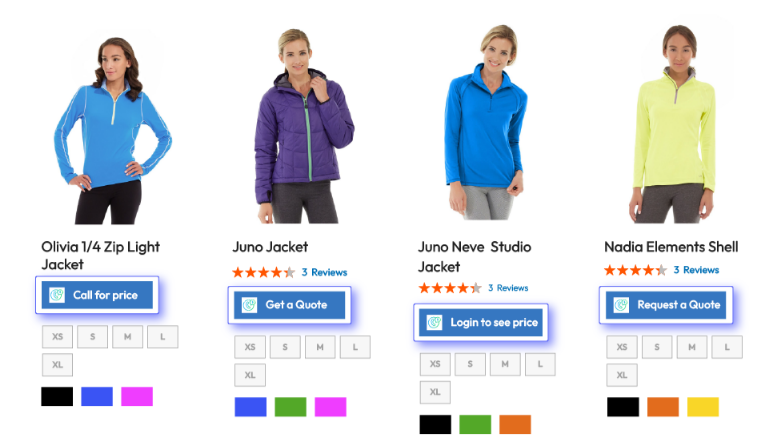
- Segregating price visibility: Magento 2 Call for Price conceals pricing from guest users. Instead of a bare product page, an unverified visitor sees a “Register to view wholesale pricing” prompt, or the “Buy Now” button is swapped for a custom contact form, so competitors browsing anonymously never see your real rates.
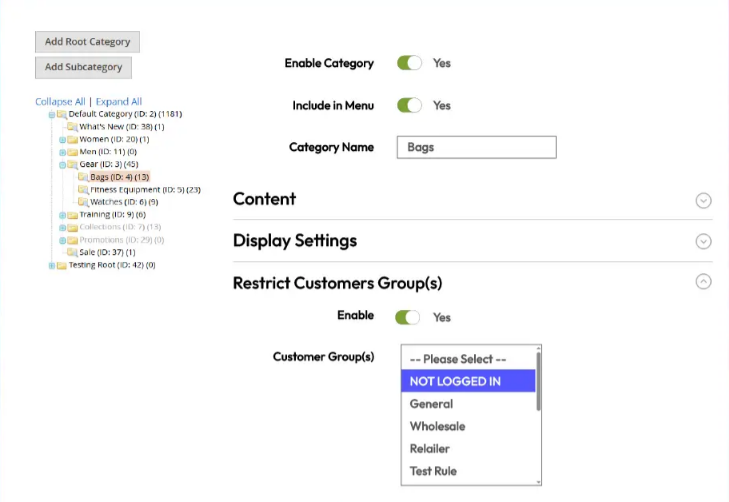
- Personalizing product catalogs: Catalog Permissions restricts category access by customer group. A concrete setup might look like: a “VIP Distributors” group sees an exclusive early-access category and negotiated SKUs, a general “Wholesaler” group sees the standard B2B catalog, and guests only ever see the public retail catalog, all from the same storefront without maintaining separate sites.
💡 Tip: Segment partners early (Wholesaler, Distributor, VIP) to run an effective pricing strategy. Check out our step-by-step guide to Customer Group Pricing to map these rules.
2. Slow lead verification and messy corporate accounts
Problem
Magento 2 default signup form cannot capture business data like Tax IDs or licenses, forcing your sales team into slow, manual follow-ups. Worse, once a business signs up, letting every employee create a separate account makes tracking budgets and credit limits an operational headache.
For example: Take a hardware distributor’s client with five employees buying from your store, each with a separate personal account. Finance can’t see combined spend, and there’s no shared budget limit to stop any one of them from overspending.
Solution
Digitalizing verification and account structure: B2B Signup adds custom fields (Tax ID, business license) to your registration form, automatically tagging applications and alerting your sales admin. The Pro edition also bundles Company Accounts, so corporate clients can manage their own staff directly on your site, purchasing managers creating sub-accounts, setting approval limits, and assigning budgets without your team getting involved, all from a single extension.
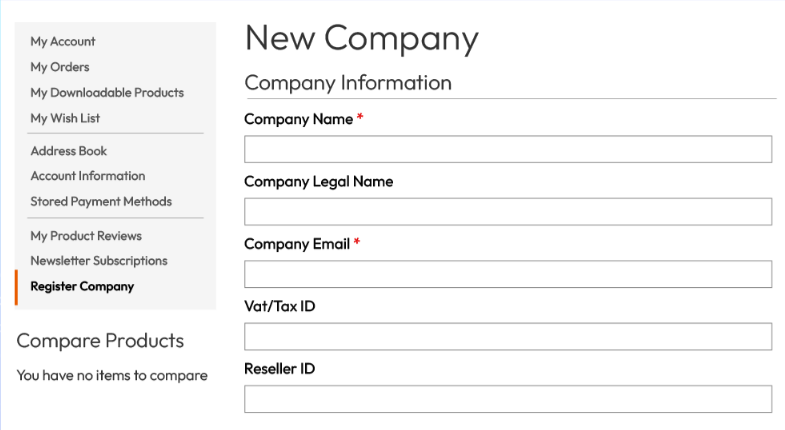
This kind of self-service setup also matches where B2B buyer expectations already are: 61% of B2B buyers now say they prefer a rep-free buying experience overall (Gartner), which means fewer manual handoffs from your sales team aren’t just an internal efficiency win, they’re what buyers are increasingly expecting by default.
💡 Tip: Letting clients self-manage staff permissions removes a large share of the manual reconciliation work your team would otherwise carry. Read our targeted guide on boosting B2B sales with Company Accounts.
3. High cart abandonment due to slow bulk ordering
Problem
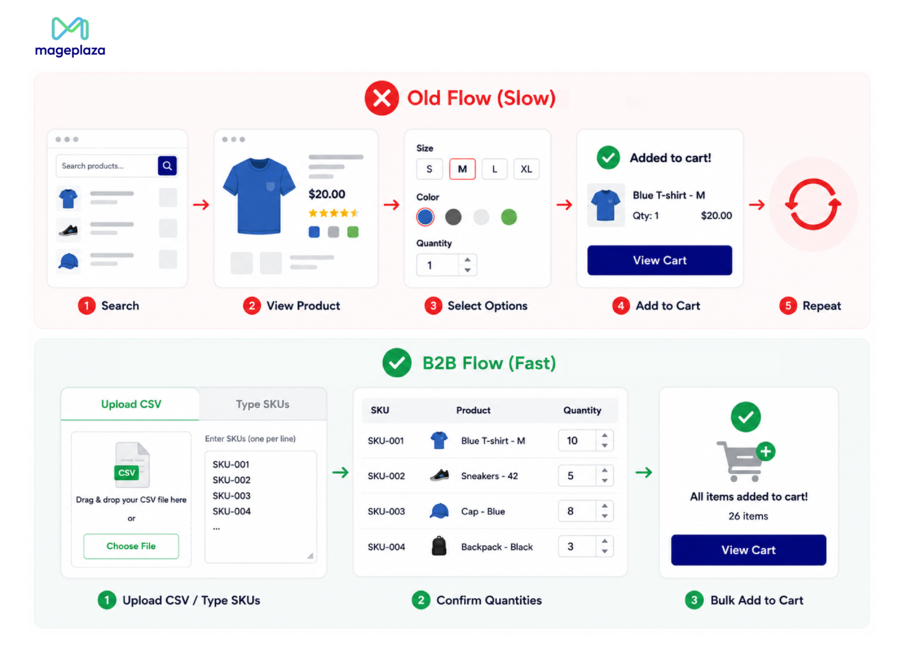
B2B buyers purchase dozens or hundreds of SKUs from pre-made lists. Forcing them to search, open individual product pages, select options, and add to cart one by one is an exhausting experience that drives them to competitors, and it shows up directly in the abandonment numbers cited above.
Solution
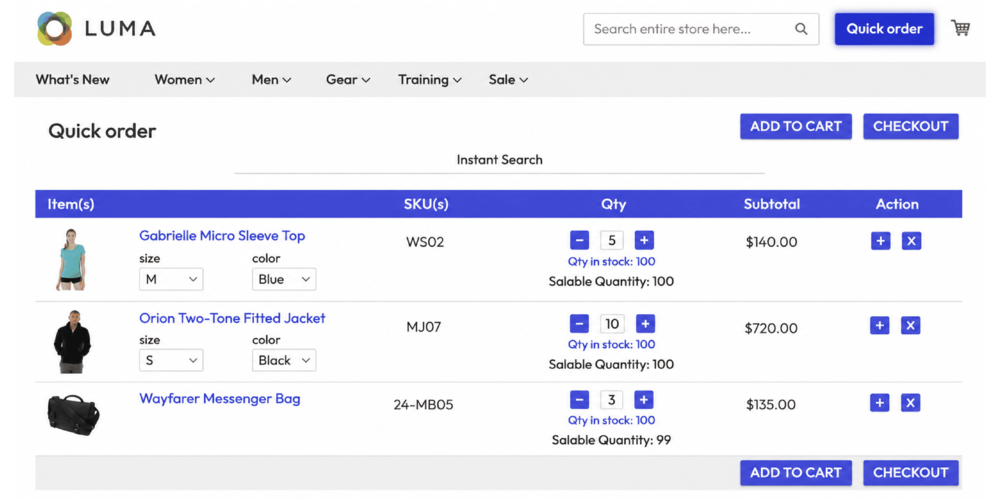
Bulk ordering in seconds: Magento 2 Quick Order lets wholesale clients skip catalog browsing entirely. In practice, a buyer with a 200-SKU recurring order can either paste in a list of SKUs and quantities directly into a fast search bar, or upload the same CSV file they already use for internal purchasing, and have the entire cart populated in one action instead of 200 individual “add to cart” clicks. It also supports quick reordering from past purchase history, which matters for buyers who order the same core list every month with small variations.
💡 Tip: Don’t stop at ordering speed — B2B buyers also expect industry-standard payment methods like purchase orders, bank transfers, or net terms at checkout. If your current checkout only supports card payments, that gap will undo the time you just saved them.
4. Broken price negotiation for large orders
While Pain Point 1 controls who sees a price, this is about negotiated pricing for large wholesale deals — a different problem with a different fix.
Problem
Fixed catalog prices are rarely final for bulk buyers. If your site forces immediate checkout at retail rates, clients will leave. Forcing negotiations over email or chat leads to lost details and long sales cycles, which is consistent with buyers’ broader preference for handling this digitally rather than through back-and-forth messaging.
For example: A large order for a coatings distributor, for instance, might involve three rounds of counteroffers spread across email threads and phone calls, with the final agreed price never actually recorded anywhere the buyer can check out against.
Solution
Digitize the entire negotiation process natively inside Magento:
- Replacing “Buy Now” with “Request a Quote”: Request for Quote lets clients submit custom pricing requests directly from their shopping cart. For the coatings distributor scenario above, the buyer would add their full order to the cart, click “Request a Quote” instead of checkout, and submit it in one step instead of drafting an email.
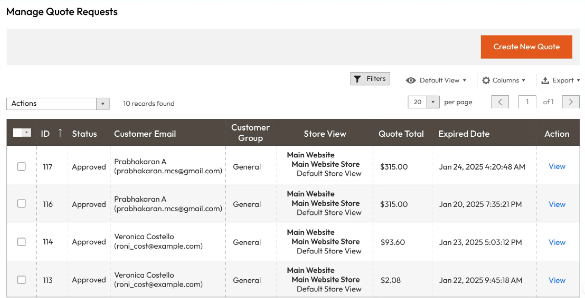
- Two-way negotiation dashboard: sales reps and clients exchange counteroffers directly in the customer’s “My Account” area, so the whole negotiation stays in one place instead of scattered emails and calls. Once approved, the quote converts into a checkout-ready order in one click, at the exact price both sides agreed on.
5. Rigid pricing rules that kill large sales
Unlike Pain Point 4 (negotiation), this is about automating predictable wholesale discounts — orders where the pricing logic is stable enough to run itself.
Problem
The goal of wholesale is to get clients to buy 100 units instead of 10. But your sales team cannot manually calculate custom discounts for every visitor 24/7. Without visible savings incentives, buyers won’t grow their cart size, and the revenue left on the table is measurable: tiered pricing structures increase average order value by 25 to 40% compared to flat wholesale pricing (McKinsey).
Solution
Automating bulk incentives: Better Tier Price displays a transparent volume discount grid directly on the product page, visible before checkout. As buyers adjust the quantity field, the unit price and total update live, so the savings are visible upfront instead of a surprise at checkout, and sales reps no longer have to manually approve one-off bulk discounts for every recurring order.
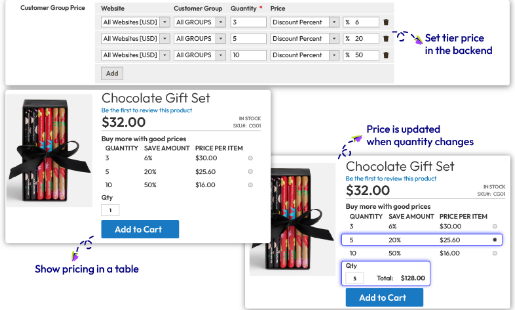
For example: 3 units or more gets 6% off, 5 or more gets 20% off, and 10 or more gets 50% off. The buyer sees these thresholds and the potential savings before they check out.
Once these 5 are resolved, you’ve covered the most common friction points. If you’re building out your B2B strategy further, 9 features of B2B e-commerce that make a powerful platform is a good next read.
Strategic Roadmap: Mapping B2B Pain Points to Phased Solutions
You don’t need to deploy every feature at once. A phased, budget-friendly rollout based on operational urgency ensures a smooth transition for both your team and your buyers.
| Implementation Phase | Real-World Business Challenge | Recommended Solution | Operational Impact & Resources |
|---|---|---|---|
| Phase 1: Security & Verification (Immediate) | Leaking wholesale prices; exposing product catalogs to competitorsSlow, manual customer verification; chaotic client employee account management | Hide Price & Catalog Permissions B2B Signup |
Protects wholesale margins; personalizes catalog visibility by distributor tier Automates onboarding and verification; delegates hierarchy and budget management to the client. 👉 See top B2B website designs for storefront presentation at this stage. |
| Phase 2: Order Velocity (Mid-term) | High cart abandonment; slow manual SKU search and add-to-cart | Quick Order | Cuts bulk ordering time for hundreds of SKUs down to seconds via CSV upload or instant search. 👉 See our Magento 2 ERP integration guide for back-office data sync. |
| Phase 3: Quote Automation (Long-term) | Scattered price negotiations across fragmented channels (email, chat, etc.); low Average Order Value (AOV) with no incentive to buy in larger volumes | Request for Quote Better Tier Price |
Centralizes negotiation and counter-offers on-site, shortening the sales cycle; drives high-volume purchases through automated, visible bulk discount grids, a good stage to revisit pricing strategy across distributor tiers |
FAQs
Does Request for Quote replace my sales team?
No. It replaces the manual, back-and-forth part of price negotiation (email threads, missed details, slow follow-ups), but sales reps still review, counter, and approve quotes through the same dashboard. It’s designed to shorten the process, not remove people from it.
Do I need to deploy all 5 solutions (8 extensions) at once?
No. Most stores don’t. Start with Hide Price and Catalog Permissions since protecting your margins matters immediately, then add the others as specific pain points above become urgent for your store.
Will hiding prices from guests hurt my SEO or conversion rate from new visitors?
It can reduce visibility for casual browsers, which is the tradeoff. Most stores handle this by keeping general product pages public and only gating specific wholesale-tier pricing, so search visibility isn’t fully lost.
Can Company Accounts and Request for Quote work together?
Yes. A common setup is Company Accounts handling who’s allowed to buy and at what approval limits, while Request for Quote handles what they pay for non-standard or large orders. They’re often deployed together rather than as alternatives.
Conclusion
A better B2B experience isn’t about adding every feature labeled “B2B” — it’s about removing friction from the moments that matter most to business buyers: registration, access, pricing, and ordering. As your business grows, combining these features into a unified system like the Magento 2 B2B Solutions ensures a highly connected purchasing journey built around your actual requirements.
Not sure which combination fits your business model best? Contact a Mageplaza expert to walk through your specific setup and architect the right roadmap for your store.
Table of content

Jacker is the Chief Technology Officer (CTO) at Mageplaza, bringing over 10 years of experience in Magento, Shopify, and other eCommerce platforms. With deep technical expertise, he has led numerous successful projects, optimizing and scaling online stores for global brands. Beyond his work in eCommerce development, he is passionate about running and swimming.
Related Post

16 mins read
|
08-30-2026
5 mins read
|
07-30-2026
7 mins read
|
06-30-2026

How to Enable DebugView in GA4 for your Magento 2 store - Mageplaza
Step-by-step guide to enabling GA4 DebugView for Magento 2 merchants — verify your GA4 events are firing correctly before trusting your data.
8 mins read
|
06-09-2026
Table Rate Shipping in eCommerce: A Practical Guide
Master Magento 2 Table Rate Shipping. Learn how to configure an accurate, automated shipping matrix to optimize your checkout and boost sales.
10 mins read
|
06-02-2026
15 mins read
|
09-30-2026
16 mins read
|
08-30-2026
5 mins read
|
07-30-2026
7 mins read
|
06-30-2026
How to Enable DebugView in GA4 for your Magento 2 store - Mageplaza
Step-by-step guide to enabling GA4 DebugView for Magento 2 merchants — verify your GA4 events are firing correctly before trusting your data.
8 mins read
|
06-09-2026
Table Rate Shipping in eCommerce: A Practical Guide
Master Magento 2 Table Rate Shipping. Learn how to configure an accurate, automated shipping matrix to optimize your checkout and boost sales.
10 mins read
|
06-02-2026