



2 mins read
|
10-30-2026
Ecommerce Trends 2027: 12 Shifts Every Retailer Must Prepare For
Summer Nguyen
|
08-05-2026


Source
Source
Source
Ecommerce now splits into two jobs: selling to real human shoppers, and being readable by the AI agents buying on their behalf. Most stores do the first well and stay invisible to the second, because AI agents don’t feel a brand story. They read structured data.
Global ecommerce sales are expected to hit $8 trillion by 2027, or 22.6% of total retail (Statista). But the more telling number about how people actually shop is this: 65% of US consumers trust AI to compare prices, yet only 14% would let it place the order (commercetools, 2026). That 51-point gap is the real story: shoppers want AI to help them decide, not to decide for them.
Below are the 12 trends that matter most, for retailers and B2B wholesalers alike.
Part 1: How AI is reshaping eCommerce behavior
Three AI trends are reshaping how people shop, and together they blur the line between traditional and intelligent commerce.
1. Agentic Commerce & GEO/AEO: When your buyer isn’t human
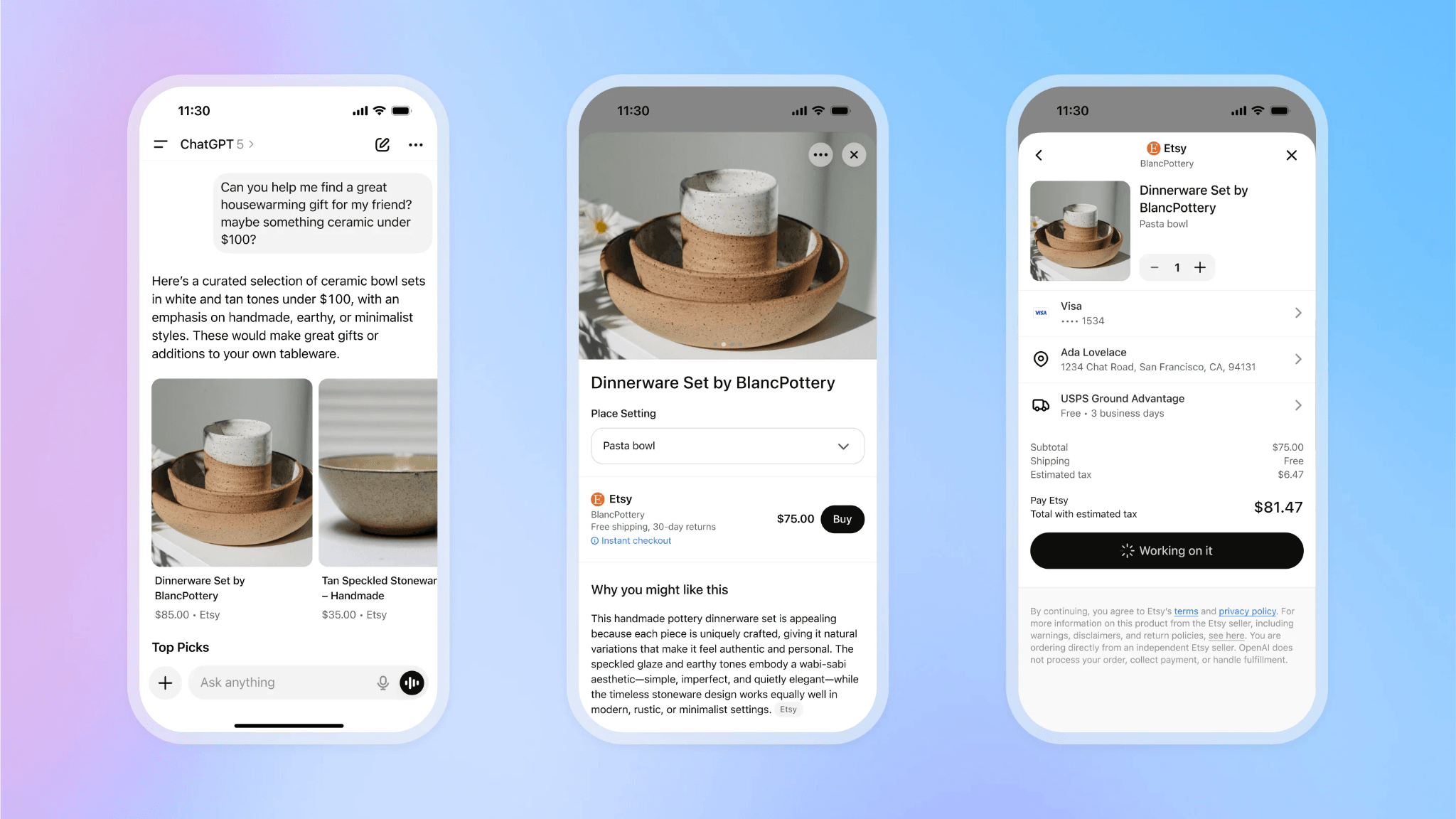
Customers no longer browse hundreds of pages. They say: “Buy me cushioned running shoes under $120, delivered by Friday.” AI handles the rest. This has already started: OpenAI launched Instant Checkout in ChatGPT via the Agentic Commerce Protocol built with Stripe, letting users buy from Etsy and Shopify merchants inside the chat window (Stripe, Sept 2025). Google has its Universal Commerce Protocol; Microsoft has Copilot Checkout.
GEO/AEO is the same story. Before AI can buy from you, it has to find you, and both depend on one thing: whether your data is clean and structured enough for machines to read. AI doesn’t feel a brand story; it reads schema. Open a product page with a long brand introduction and you’ve lost, because AI pulls its answer from the first 2–3 sentences and cites just one source.
📌 What you can do today:
- Standardize product data with Schema.org markup. Start with this Magento 2 SEO and structured data guide.
- Put the direct answer in the first 2–3 sentences of every page, and build a Q&A base around real customer questions.
- Keep pricing and inventory accurate in real time. Wrong data is worse than none, because agents drop you from results entirely.
2. Virtual try-on and 3D/AR: letting customers try before they buy
Returns are the quiet cost eroding margins, especially in fashion and furniture, where shoppers can’t picture how a product looks in their space. 3D/AR and Virtual Try-On solve that: “wear” the glasses, “place” the chair in the living room, right from a phone. It cuts returns and, more importantly, cuts hesitation on higher-priced items.
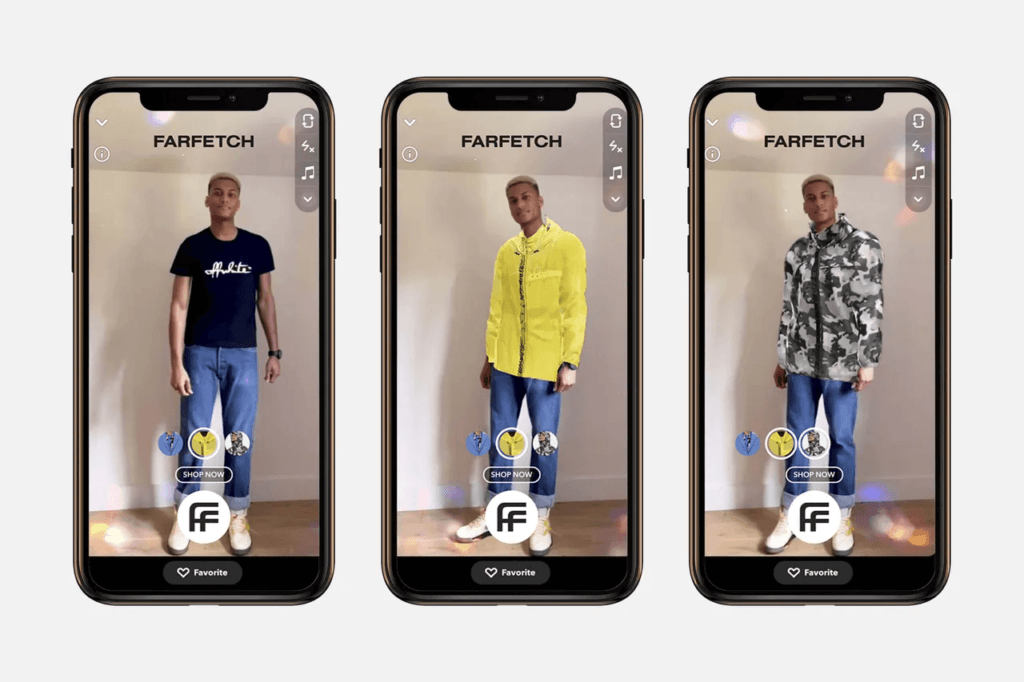
Example: Farfetch and other brands, such as Prada, have partnered with Snapchat to introduce virtual try-ons.
But be clear-eyed about cost. Producing 3D models across a full catalog isn’t cheap, and not every category earns the ROI. Furniture, jewelry, and eyewear benefit clearly; fast-moving consumer goods barely at all. Worse, if a model misrepresents color, size, or material, you’ll increase returns by setting wrong expectations.
📌 What you can do today:
- Embed 3D/AR models (.glb, .usdz) for high-value or high-return products, not the entire catalog.
- Compare return rates for products with VTO against those without before scaling the investment.
- Prioritize accuracy over beauty: a wrong-color model does more harm than none at all.
3. AI customer service: how much automation is enough?
AI customer service has moved past scripted chatbots: it reads live order data, answers in natural language, and completes tasks like returns or refunds without a human touching the ticket. AI currently handles about 30% of customer service cases and is expected to reach 50% by 2027 (Salesforce, 2025).
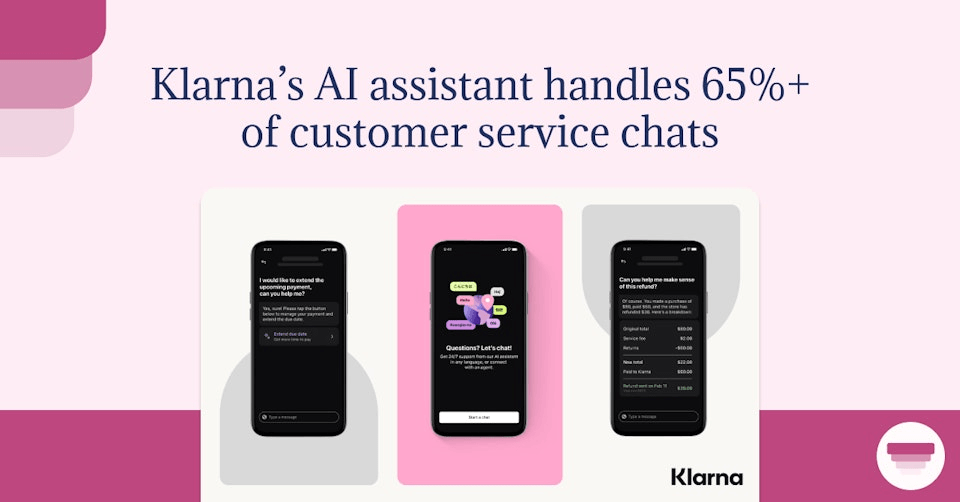
Klarna is the textbook example. Its AI assistant took over two-thirds of global chats (Klarna, Feb 2024). But the story doesn’t end there. Klarna later rehired human staff, because over-automation hurt satisfaction in complex cases needing empathy (CX Dive, May 2025).
The lesson isn’t “don’t use AI.” It’s that the wrong metric leads you the wrong way. Track only automation rate and an AI that answers fast but forces three follow-ups looks like a win on the report.
📌 What you can do today:
- Train your AI assistant on your own product documentation and store policies, not an untuned general-purpose model.
- Connect it to ERP/CRM to automate repetitive workflows: order tracking, returns, credit codes.
- Guarantee instant handoff to a human for complex issues, and measure by first-contact resolution.
Part 2: The multi-polar sales channel ecosystem
In the future of ecommerce, sales channels keep multiplying. Customers might find you on TikTok, buy on your website, pick up in store, and return through your mobile app. Retail trends 2027 show that merchants need to be present in many places while staying consistent across all of them.
4. Social commerce 2.0: rented land or your own foundation?
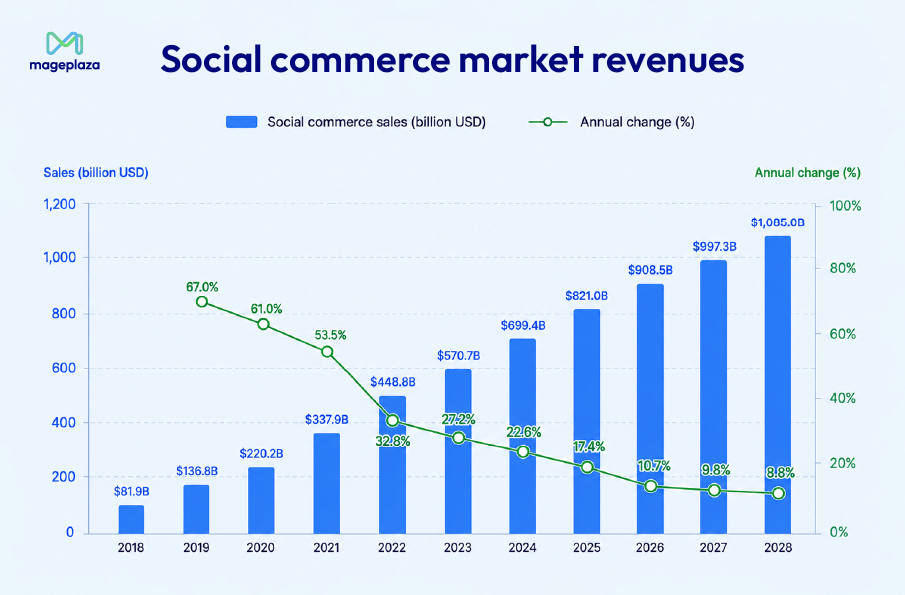
Social commerce is set to account for around 20% of all global ecommerce by 2027, and in the US it crossed $100 billion for the first time in 2026, up 18% year over year (eMarketer). TikTok Shop alone hit $15.8 billion in US sales in 2025, more than doubling year over year, which makes its US ecommerce business bigger than Target’s or Costco’s.
But a viral video isn’t a profitable one. Platform fees, creator commissions, and returns can eat 35–55% of revenue (Shortform Nation, 2026), and US growth is cooling year over year. Building on rented land erodes margin, so treat social as a funnel for acquiring customers, then optimize the experience that brings them back.
📌 What you can do today:
- Build dedicated affiliate storefronts for creators with 1-click in-app checkout.
- Sync your catalog automatically across platforms. See more on multichannel selling strategy.
- Bring social proof back to your own site and track each channel’s revenue separately.
5. Unified commerce: when online and offline stop being separate
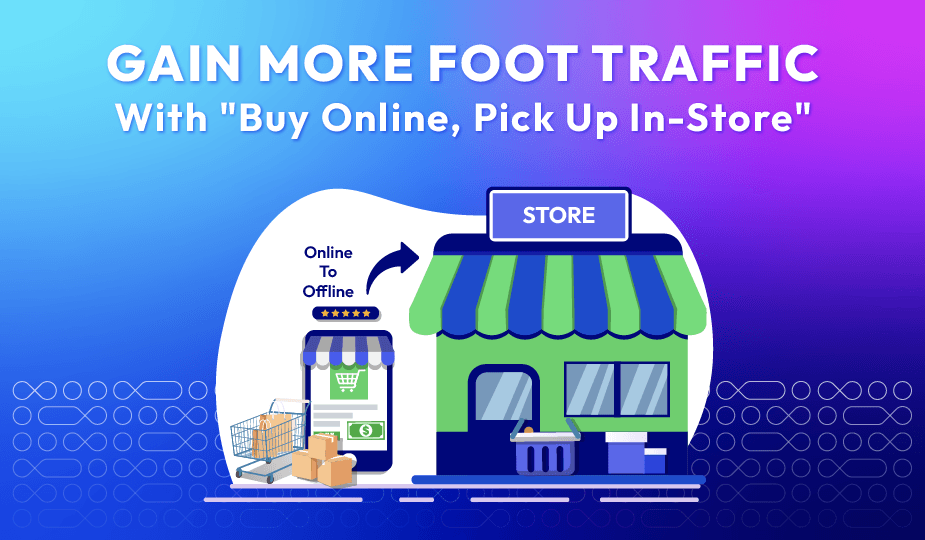
BOPIS and click & collect are no longer premium features. They are baseline expectations. Picture it: a customer adds an item in your app, visits the store, and a staff member pulls up that exact cart on the POS, applies a member discount, and arranges home delivery. Multiple channels, one shopping trip.
So what’s holding this back? Not frontend design. Usually it’s legacy ERP systems that can’t sync in real time. This is the trend easiest to agree with and hardest to execute. Plenty of retailers announce “omnichannel” while syncing in batches. And nothing breaks trust faster than “in stock online, sold out in store.”
📌 What you can do today:
- Prioritize real-time inventory sync between website and POS/ERP before flashier phygital features.
- Roll out click & collect and route customers to the nearest pickup point.
- Make customer data (purchase history, loyalty points) visible both online and at the counter.
6. B2B ecommerce digitalization: when B2B wants B2C speed convenience
B2B buyers didn’t wait for permission to go self-service. Gartner found 61% now prefer a rep-free buying experience, and in-person selling generated just 17% of B2B revenue in 2024, down 22% from two years earlier (Salsify). A procurement manager ordering 500 units no longer emails and waits 48 hours; they log in, see tiered pricing, run approvals, and finish in five minutes.
But not every B2B buyer wants self-service. Complex, high-value deals still turn on the sales relationship. The shift is in the default: self-service takes the repeat, low-risk orders and frees your team for strategic accounts.
📌 What you can do today:
- Build a self-service portal for order management, quotes, and fast reordering. See the B2B extension suite for Magento 2.
- Enable tiered pricing and automated quoting for corporate customer groups.
- Standardize product data, pricing, and delivery terms for machine readability. B2B catalogs need this more urgently than B2C.
Part 3: The 2027 customer experience standard
Customer experience is where most competition now happens, and the bar keeps rising. Shoppers expect speed, convenience, and personalization that feels intelligent rather than intrusive.
7. Frontend performance: Luma, Hyvä, or headless?
Sub-2-second load times are mandatory now. According to ecommerce statistics 2027, mobile is expected to account for roughly 62% of global ecommerce sales (Statista). In the Magento ecosystem, you have three options:
| Architecture | Load Speed / Performance | Development & Maintenance Cost | Best Suited For |
|---|---|---|---|
| Luma (Legacy) | Slow / Complex optimization | Low initial cost, high technical debt | Legacy stores preparing for migration |
| Hyvä Themes | Ultra-Fast (90+ Google PageSpeed) | Moderate cost, fast time-to-market | Merchants wanting top performance without Headless overhead |
| Headless / PWA | Ultra-Fast / App-like | High initial & ongoing dev cost | Enterprise brands with multi-platform touchpoints |
Hyvä replaces Luma’s legacy stack (RequireJS, KnockoutJS, jQuery) with Alpine.js and Tailwind CSS, cutting JavaScript payload and improving Core Web Vitals. Because the Magento backend stays untouched, migrating from Luma to Hyvä is a frontend project, not a rebuild of the whole store.
But don’t migrate just to follow a trend. For smaller stores, compressing images, cutting plugins, and adding a CDN often delivers ROI far faster than a full rebuild. Measure first.
📌 What you can do today:
- Check your mobile PageSpeed score against 2–3 direct competitors.
- If you’re on Luma and speed is genuinely your bottleneck, check which of your extensions are Hyvä-ready before committing to the move.
- Choose Headless only if you truly need multiple complex frontends, not just to look modern.
8. Generative UI and personalization: when does it go too far?
Generative UI adapts layout, banners, and recommendations to each visitor’s context: weather, device, traffic source, browsing history. A shopper in New York during a cold snap sees heavy coats; one in Miami sees lightweight jackets.

H&M shows this on its product pages. As a shopper browses colors, checks sizes, or scrolls, blocks like “Styled with” and “Similar items” refresh automatically, surfacing matching outfits and close alternatives based on what the shopper just did.
But there’s a fine line. (Qualtrics’ 2026 research) found 64% of consumers prefer personalized experiences, yet only 39% think the benefits outweigh the privacy cost. What bothers customers isn’t personalization itself. It’s data used that they didn’t know they’d shared.
📌 What you can do today:
- Start with contextual signals you already have, on high-traffic pages first.
- Personalize the offer at the decision point, like JCPenney’s in-cart coupon, rather than discounting the whole catalog.
- A/B test every change, and switch it off if it doesn’t perform.
- Personalize abandoned cart recovery, where ROI is clearest.
9. Frictionless payments: every second of delay costs a customer
Digital wallets now account for 56% of global ecommerce spend (Worldpay, Global Payments Report 2026). Biometric checkout is replacing OTPs and passwords, and BNPL is standard in fashion and electronics.
Read more: How to Configure Payment Methods in Magento 2
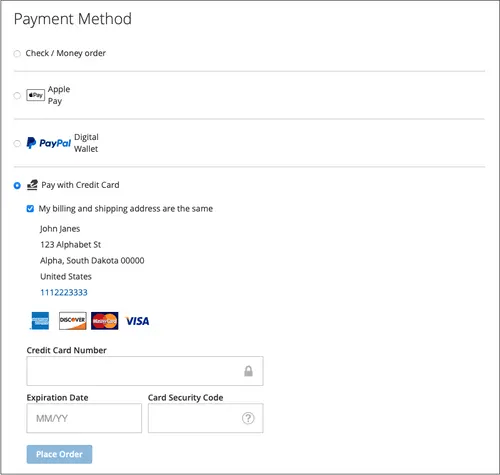
But here’s the surprise: friction at the top of the funnel drives more abandonment than a missing payment method. Forcing account creation costs you more customers than not offering Klarna. Enable guest checkout by default, let people buy first and register after, and surface wallets and BNPL early rather than at the last step.
One balancing note: BNPL lifts short-term conversion but carries consumer debt risk and growing regulatory pressure around fee transparency. Show the terms clearly instead of only advertising “0% installments.”
📌 What you can do today:
- Compress checkout into one step checkout.
- Turn on guest checkout by default, with account creation after purchase, not before.
- Surface wallets and BNPL early in the journey.
Part 4: Trust and regulatory barriers
Beyond technology, the next two years are shaped by legal requirements and trust. Selling well is no longer enough. You have to earn trust and stay compliant.
10. Zero-party data: your new asset
With third-party cookies gone, Zero-party data, meaning what customers willingly share, becomes your most valuable resource. So how do you get them to share it? Value. A beauty brand’s “Find your skin type” quiz works because the shopper gets a relevant recommendation immediately.
The core principle: give value before asking for data. Quizzes, assessments, and product advisors collect data naturally because both sides benefit. And don’t skip transparency. 2027 customers want to know how AI uses their data. Labeling AI content and allowing personalization to be switched off builds more trust than any campaign.
📌 What you can do today:
- Build a loyalty program that rewards customers for sharing preferences.
- Replace dry data-capture forms with tools that return value instantly: advisor quizzes, size finders, comparison tools.
- Label AI content clearly and allow personalization to be turned off.
11. Digital product passports: from requirement to retention tool
The ESPR (Regulation EU 2024/1781) has been in force since July 2024, but it’s a framework: product-specific rules arrive through delegated acts, and the first hard deadline comes from a separate law entirely (Complir, 2026).
| Category | Passport required | Legal basis |
|---|---|---|
| Batteries | 18 February 2027, no transition period | EU Battery Regulation |
| Textiles | Around late 2028 | ESPR delegated act |
| Electronics | 2028–2029 | ESPR delegated act |
| Appliances, furniture | 2028 onward | ESPR delegated act |
Products without a valid passport can be refused at the EU border.
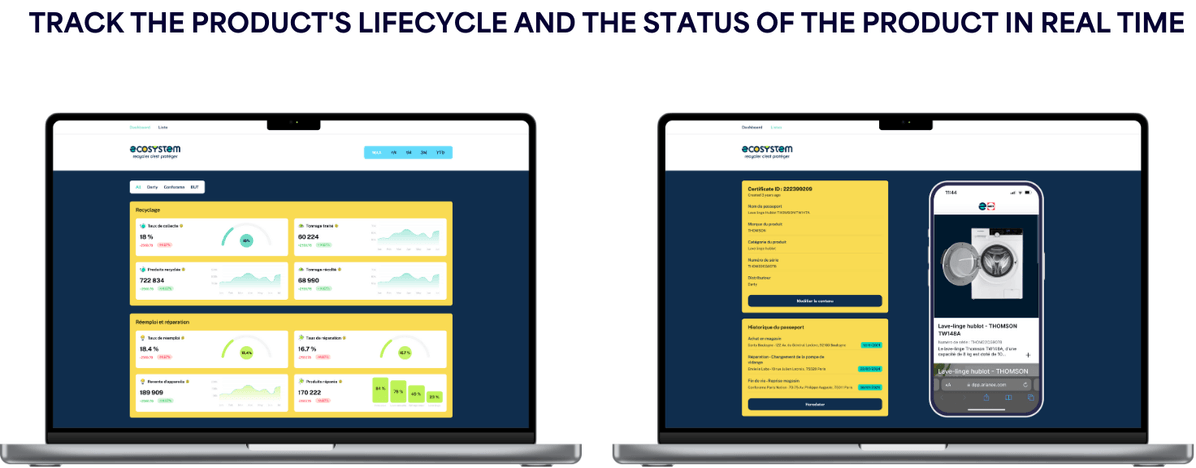
French retailer Darty treated this as infrastructure rather than burden: over 200,000 QR-accessible passports across its stores, one passport satisfying ESPR, WEEE, and AGEC at once (Arianee). Appliances aren’t required to have a DPP until 2028, but Darty built the pipeline early.
The rules apply to any product placed on the EU market regardless of where the company sits, so budget the PIM upgrade early.
📌 What you can do today:
- Upgrade your PIM to store supply chain data to DPP standards.
- Highlight sustainability information on product pages, since AI agents read this too.
- Pilot a trade-in program with store credit, turning resale into a retention loop.
12. EAA compliance: the deadline that already passed
The European Accessibility Act has been in force since June 28, 2025 (Bird & Bird). Ecommerce sites serving the EU that fail accessibility standards face genuine legal exposure, assessed against EN 301 549, which is built on WCAG.
Here’s the useful part: Keyboard-inaccessible buttons, low contrast, and missing alt text create friction for disabled users and rushed shoppers alike.
Run these checks on your live store, because a failure here may be a genuine legal exposure under the EAA, not just a UX nicety.
| What to check | How to test | Fail if | |
|---|---|---|---|
| 1 | Skip link | Load the homepage, press Tab once | No "Skip to content" link appears, forcing users through the full header every page |
| 2 | Focus visible | Tab down the page and watch the focused element | No visible outline on the focused element. (Focus hidden behind a sticky header fails WCAG 2.2, which EN 301 549 has not yet adopted.) |
| 3 | Minicart modal | Add to cart, then Tab | Focus doesn't move into the minicart, Esc doesn't close it, or focus escapes to the page behind |
| 4 | Search autocomplete | Type in search, use arrow keys | Suggestions unreachable by keyboard, or new results not announced to screen readers |
| 5 | Layered nav price slider | Tab to the price filter, press arrow keys | Slider can only be dragged with a mouse, with no keyboard or numeric input alternative |
| 6 | Filter result announcement | Apply a filter with a screen reader on | Product count updates silently, with no live region announcing the change |
| 7 | Color swatches | Tab to swatches, press Enter or Space | Swatches unreachable, or the selected state shown by border alone with no text or ARIA state |
| 8 | Product gallery | Tab into the gallery, try arrow keys | Can't move between images, or the lightbox traps focus with no Esc exit |
| 9 | Add-to-cart confirmation | Add a product, listen or watch | Success message appears visually only, never announced or focused |
| 10 | Checkout step change | Move from shipping to payment | Focus stays at the bottom of the previous step, and the new step isn't announced |
| 11 | Form error messages | Submit checkout with fields empty | Errors indicated by red border or color alone, not linked to the field, or focus not moved to the first error |
| 12 | Billing = shipping checkbox | Toggle it with Space | Revealed fields aren't announced, or focus order jumps unpredictably |
| 13 | Login / register CAPTCHA | Reach the CAPTCHA by keyboard | Image-only CAPTCHA with no audio or non-visual alternative |
| 14 | Contrast and 200% zoom | Run WAVE, then set browser zoom to 200% at mobile width | Body text below 4.5:1, large text below 3:1, or content overlapping and forcing horizontal scroll |
Fix checkout first. It’s where the legal risk and the lost sales overlap, and where those four flagged items hurt most. Then write the criteria into your design system, or they’ll quietly break again with the next theme update.
Strategic Roadmap: Prioritizing 2027 trends by merchant scale
No business needs to tackle all 12 at once. The table below distills the 12 trends into a practical priority order for each merchant tier:
| Business Size | Strategic Focus | What to Do Now | Effort & Budget |
|---|---|---|---|
| Small / SMB | Conversion rate optimization (CRO) & basic data standardization | • Optimize one-step checkout (One Step Checkout) • Implement Schema.org for AI Search & GEO/AEO • Collect zero-party data via quizzes |
Low – Moderate (Achievable in a few weeks, minimal cost) |
| Mid-Market | Site speed, customer retention & channel expansion | • Migrate the frontend to Hyvä Themes • Automate marketing via Reward Points & Cart Recovery • Sync multichannel social commerce |
Moderate – High (Requires modest IT resources and infrastructure budget) |
| Enterprise | B2B process automation, AI agents & regulatory compliance | • Deploy a B2B self-service portal • Integrate agentic AI commerce & real-time ERP • Standardize DPP data & WCAG 2.2 AA |
High (Requires a specialized technical team and long-term roadmap) |
💡 Three Lessons That Apply at Any Scale
- Clean data comes before shiny technology. Schema markup costs far less than Headless, yet it's the prerequisite for surviving the AI agent era.
- Measure the right metric, not the easy one. Klarna optimized for automation rate and paid for it in customer satisfaction.
- Measure before you invest. Check your own PageSpeed, cart abandonment rate, and inventory sync lag - then decide where the money goes.
FAQs
Will AI agents account for most ecommerce orders by 2027?
No. Bain forecasts 15–25% of US ecommerce running through AI agents, but not until 2030. Build the infrastructure now; human shoppers still generate most of your revenue.
Why Hyvä over headless for most Magento 2 stores?
Hyvä delivers high performance while keeping the Magento backend intact, cutting development and maintenance cost. Headless only pays off with multiple complex frontends like apps or kiosks.
How does AI customer service differ from a chatbot?
Chatbots follow rigid decision trees. Agentic AI understands natural language, reads live ERP/CRM order data, and executes returns or shipment tracking itself. The real risk isn’t cost; it’s measuring the wrong metric, as Klarna showed.
Which trend should small retailers do first?
Schema markup, one step checkout, and real-time inventory sync if you sell offline too. Costlier bets like 3D/AR or headless depend on your category.
Are Digital Product Passports mandatory outside the EU?
Not unless you sell into the EU. But if expansion is planned, standardize supply chain data early, because PIM upgrades take longer than expected.
How do I prepare for B2A (Business-to-Agent) shopping?
Focus on data. Clean Schema.org markup plus real-time pricing and inventory feeds are what let AI agents find and buy your products. B2B catalogs need this most.
Conclusion: Preparing Your Commerce Infrastructure for 2027
All 12 trends converge on three foundations: standardized data, a flexible frontend architecture (Hyvä or Headless), and durable brand trust.
If you can only pick three things to start in 2027, the sensible order is: standardize product data so AI agents and search engines can read it, sync real-time inventory across channels, and cut friction at the top of the checkout funnel. These are the three investments with the clearest ROI regardless of company size.
2027 is no longer the time to “experiment” with new technology - it’s the time to get the priority order right, before consumers gradually hand their purchasing decisions over to AI agents.
Table of content

Summer is the CMO and Digital Commerce Solution Expert with 10+ years of experience. She specializes in Magento, Shopify, ERP, CRM, AI, and Blockchain, delivering strategic solutions that transform businesses. With a deep understanding of digital commerce, she helps brands scale and stay ahead in a competitive market.
Related Post

15 mins read
|
09-30-2026
16 mins read
|
08-30-2026
5 mins read
|
07-30-2026
7 mins read
|
06-30-2026

How to Enable DebugView in GA4 for your Magento 2 store - Mageplaza
Step-by-step guide to enabling GA4 DebugView for Magento 2 merchants — verify your GA4 events are firing correctly before trusting your data.
8 mins read
|
06-09-2026
2 mins read
|
10-30-2026
15 mins read
|
09-30-2026
16 mins read
|
08-30-2026
5 mins read
|
07-30-2026
7 mins read
|
06-30-2026
How to Enable DebugView in GA4 for your Magento 2 store - Mageplaza
Step-by-step guide to enabling GA4 DebugView for Magento 2 merchants — verify your GA4 events are firing correctly before trusting your data.
8 mins read
|
06-09-2026