


2 mins read
|
10-30-2026
Affiliate Marketing vs Digital Marketing: Affiliate Program or In-house Marketing?
Summer Nguyen
|
09-03-2026


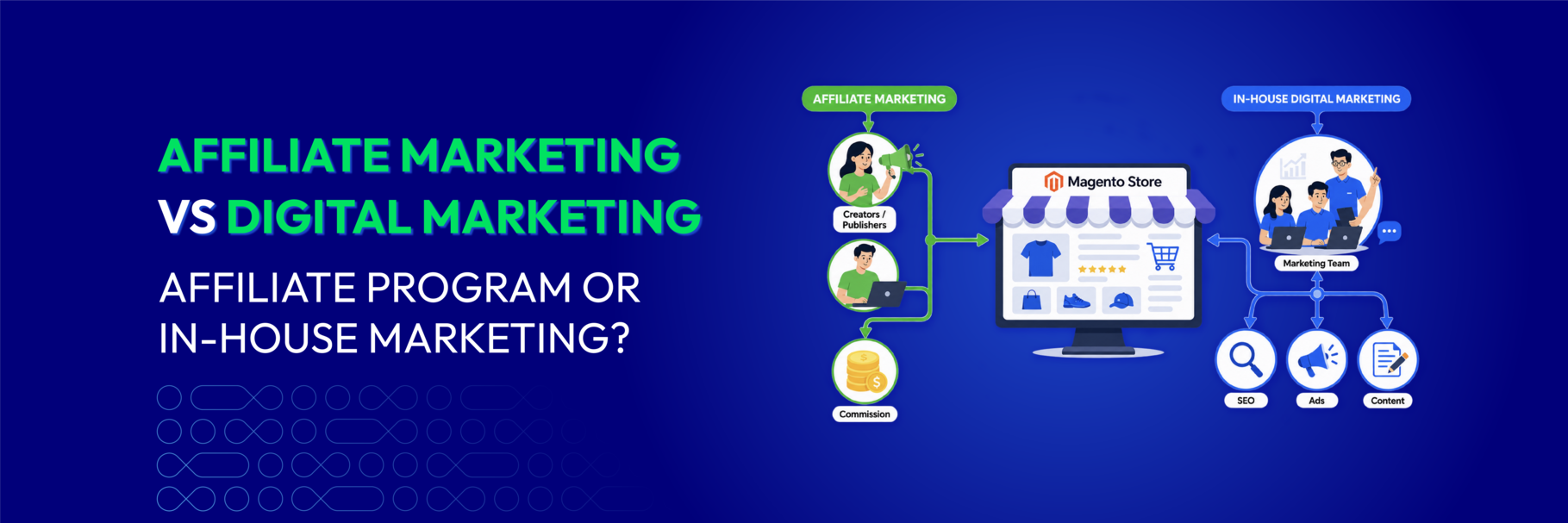
Many businesses researching marketing ask the question “should we choose affiliate marketing or digital marketing?” This question is actually framed wrong from the start. Affiliate marketing is not a competitor to digital marketing; it’s a part of it. The real question a business needs to answer is which channels to run in-house, and which ones to outsource and pay for based on results.
The distinction that matters most isn’t affiliate versus digital marketing. It’s whether you’re buying fast, rented results or building an asset you actually own. This article breaks down both operating models, Affiliate Program and In-house Digital Marketing, across cost, control, risk, and long-term asset-building, so you can decide the right mix for your budget, industry, and stage of growth.
What Affiliate Marketing really is within the Digital Marketing ecosystem
Definition and where affiliate marketing fits
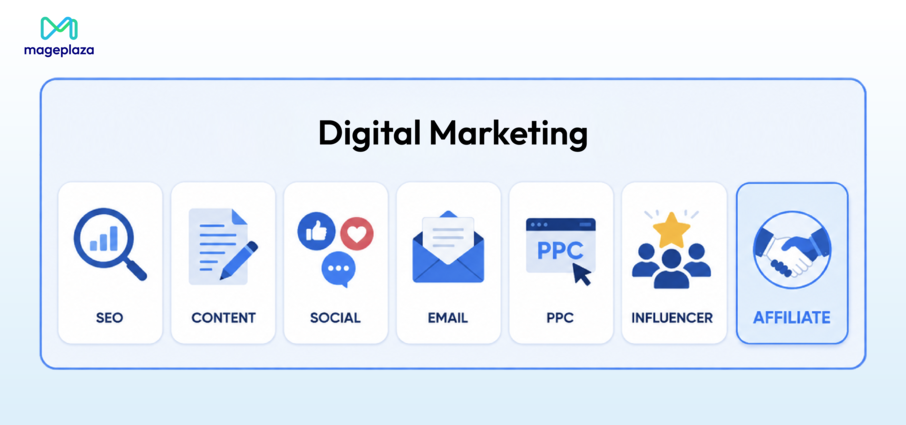
Digital marketing is the full set of marketing activities that use digital channels to reach and engage customers. It includes several branches: search engine optimization (SEO), content marketing, social media marketing, email marketing, PPC advertising, influencer marketing, and affiliate marketing.
In other words, affiliate marketing is a sub-channel that sits inside digital marketing, not a separate category standing alongside it. At its core, affiliate marketing is a model where a business pays commission to partners (affiliates/publishers) who bring in customers or sales through their own promotional efforts.
Why people confuse “affiliate vs digital marketing”
This confusion isn’t random. In practice, affiliate programs are usually fully outsourced through an affiliate network or independent partners, while other digital marketing channels (SEO, content, social, PPC) are typically managed directly by an in-house team. That difference in how each is run makes them feel like two completely separate fields, even though that’s not accurate from a classification standpoint.
The question you should actually be asking
Instead of asking “should we choose affiliate or digital marketing”, the right question is:
Which channels in digital marketing should be run in-house, and which should be outsourced and paid on performance (affiliate)?
That’s the comparison this whole article is built around.
The two operating models businesses have to choose between
Affiliate Program (Outsource, pay for performance)
An affiliate program works like this: a business invites affiliates (bloggers, website owners, KOLs/KOCs, review sites, coupon sites, independent email marketers, and so on) to promote its products or services. In return, the business pays commission based on actual results. The three most common models are:
- Pay-Per-Sale (PPS/CPS): commission paid when a sale is completed
- Pay-Per-Lead (PPL/CPL): paid when a specific action happens, such as a sign-up or form submission
- Pay-Per-Click (PPC/CPC): paid per click, regardless of whether it converts
💡 Tip: PPC is rarely used today and is a common vector for click fraud. Consider CPA affiliate marketing instead, which pays only on a verified action.
The core trait of this model: the upfront cost to the business is almost none, and the business has no direct control over how affiliates create content or promote.
In-house Digital Marketing (Build it yourself, full control)
By contrast, in-house digital marketing is when a business runs its own channels (SEO, content marketing, social media, email marketing, PPC advertising) through an internal team, or an agency hired for a project but still directed by the business itself.
The core trait: the business has to invest budget upfront (ad spend, tools, staff, content production), but in exchange gets full say over messaging, target audience, and overall strategy, from product and pricing to distribution and promotion.
Quick comparison
| Criteria | Affiliate Program | In-house Digital Marketing |
|---|---|---|
| What you own | Commission relationships, no lasting asset | Brand, content library, domain authority |
| Payment structure | Commission paid only on completed sales or leads | Fixed spend: ad budget, salaries, and tools, regardless of results |
| Startup cost | Low to none | Medium to high |
| Control | Limited, the affiliate decides | High, the business decides |
| Time to results | Can drive sales within days of launch | Typically 3 to 6 months before SEO and content show measurable traffic |
| Best fit for | Early-stage businesses, tight budgets, B2C products | Established brands with budget to invest, or complex B2B sales |
Detailed comparison across 4 key criteria
Cost and payment structure
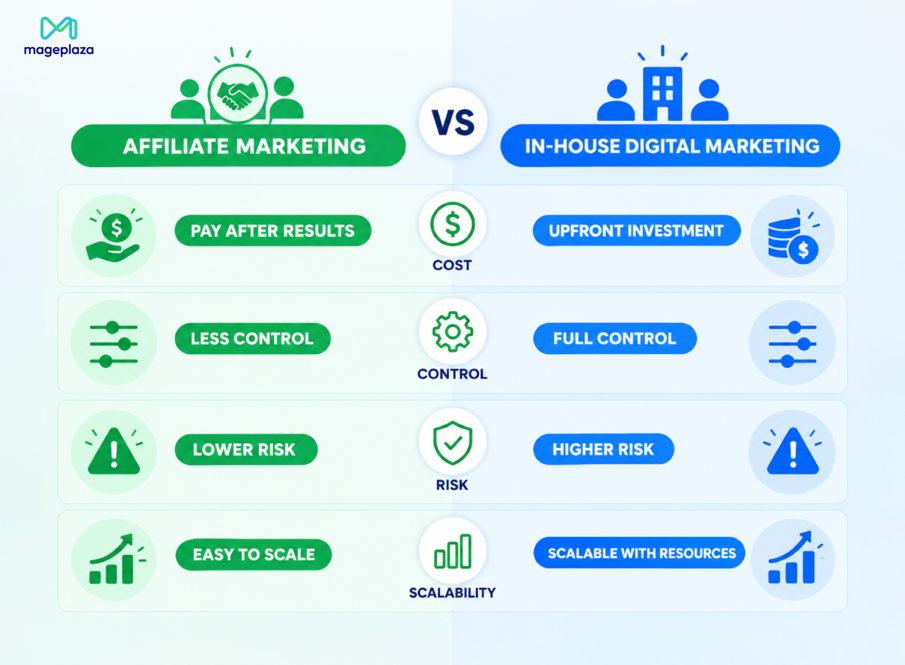
Affiliate: paid afterward, based on results, with almost no sunk cost, just commission plus a possible platform fee. Rates vary by industry: roughly 1% to 10% for physical ecommerce products (Amazon Associates, Target Affiliates), 20% to 40% recurring for SaaS (ConvertKit, ActiveCampaign, Kajabi), and 50% to 75% for downloadable digital products (ClickBank, JVZoo). See real program numbers in these affiliate marketing websites and affiliate marketing examples.
In-house: requires upfront spend across several line items: ad budget, SEO/content tools, content production, and marketing salaries. This is a model with higher fixed costs regardless of outcome.
Level of control
Affiliate: the business has no direct control over how an affiliate writes content, which channels they use, or how often they promote. A common risk is an affiliate exaggerating or misrepresenting a product to boost clicks, which can hurt brand reputation.
In-house: the business controls 100%, from messaging and targeting to publish timing and budget allocation across channels. This is the biggest advantage of the in-house model, especially for industries that need tight control over brand image.
Risk and effectiveness
Affiliate: financial risk is low since payment only happens on results, but traffic quality risk is higher: fake clicks, non-converting traffic, or affiliate fraud such as cookie stuffing. On speed, affiliates often deliver results faster because they tap into an existing audience.
In-house: financial risk is higher because spend happens before results are guaranteed, but traffic and lead quality tends to be better controlled. For SEO specifically, initial traffic gains usually show up in 3 to 6 months, but the average page in Google’s top 10 is over a year old, so full results build gradually rather than overnight.
The risk both models share: who gets the credit
A customer your email campaign already sold, or who found you through organic search, opens a second tab at checkout to hunt for a code, clicks through a coupon affiliate, and comes back to complete the order.
Three things to check before you trust the split:
- Time from click to order. A gap measured in minutes, on a visitor with no prior affiliate touch, is the signature of a checkout-stage coupon click, not a discovery.
- What share of affiliate revenue comes from coupon and deal sites specifically, as opposed to content, review, or email partners who bring genuinely new traffic.
- Whether affiliate orders skew toward returning customers. New-customer share is the honest measure of whether a partner is expanding your reach or billing you for people you already had.
If coupon partners make up a large share, the fix is a policy one, not a tracking one: pay them a reduced rate, exclude them from last-click credit, or require a referral-link click rather than a code entered at checkout. How you set the attribution window and commission rules in practice is covered in managing Magento 2 affiliate programs
Scalability and asset building
This is an important distinction that often gets overlooked when comparing the two models.
When a business invests in-house in SEO and content following the website optimization principles from Google Search Central, the result is an asset the business actually owns: domain authority, a content library, an email list. These compound in value over time and keep generating traffic even if the marketing budget shrinks later.
With an affiliate program, on the other hand, the audience and traffic belong to the affiliate, not the business. Once the partnership ends, the business loses that channel entirely; nothing accumulates for the business itself.
In short: in-house builds long-term assets, while affiliate delivers fast short-term results without accumulation.
What happens if you only run one model
Affiliate-only businesses
- Growth stays capped by what affiliates are willing to promote, since there’s no owned channel to fall back on
- Every dollar of traffic value walks out the door the moment a partnership ends
- Brand consistency erodes over time as more affiliates join with their own voice and claims
In-house-only businesses
- Growth is bottlenecked by internal headcount and budget cycles, with no fast lever to pull for a short-term spike
- New market entry is slower, since there’s no partner audience to borrow reach from
- A hiring gap or a paused budget quarter can stall an entire channel with no backup
How to Split Between the Two Models
Affiliate and in-house aren’t mutually exclusive: one buys short-term results, the other builds long-term assets. Most mature businesses run both in parallel, differing mainly in how they split the budget at each stage.
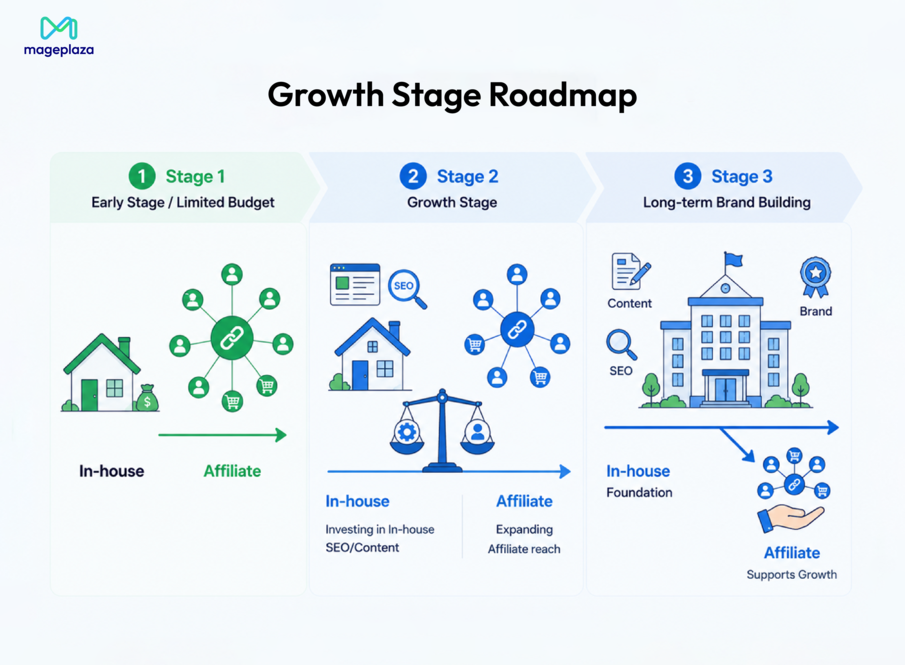
Early stage / limited budget
Prioritize setting up an affiliate program to lower financial risk and test the market quickly without a large upfront investment. This model fits best for B2C and consumer products with margins healthy enough to share as commission.
Note: complex B2B or high-AOV categories like SaaS aren’t a poor fit for affiliate, they just need a different setup: a longer attribution window and commission on qualified leads (CPL) instead of completed sales. See high-ticket affiliate marketing for how this is typically set up.
Growth stage
This is when combining the two makes sense: keep the affiliate program running to continue expanding reach quickly, while starting to invest seriously in-house, particularly in SEO and content, to build a more sustainable growth foundation.
Long-term brand-building stage
At this stage, shift budget focus toward in-house: content, SEO, and brand campaigns. Affiliate becomes a supporting channel rather than the main pillar of the overall marketing strategy.
How to decide your split
A common approach: build content and SEO in-house as a long-term foundation, and run an affiliate program alongside it to expand reach without increasing paid ad spend.
As an illustrative starting point, not a benchmark, some businesses put the majority of budget into core in-house channels and keep a smaller share for affiliate as a testing channel. The right split depends on your stage and industry, and is worth revisiting each quarter.
Three questions to answer before deciding your split:
- Can your margin absorb the commission rate and still leave profit?
- Will this be run by an in-house team, or hired out project by project?
- Do you need revenue right now, or are you building toward a 12-month base?
Your answers point you toward one model or a specific blend of both.
Running each model well
Getting the affiliate program right
- Choose an affiliate network or platform with clear, transparent tracking, or work with a dedicated affiliate marketing agency if managing it in-house isn’t realistic
- Require affiliates to disclose the paid relationship in line with the FTC Endorsement Guides if targeting international markets
- For the full setup process, from commission structure and software to recruiting and fraud checks, see how to create a successful affiliate program
- Check how affiliate codes interact with the promotions you already run, so a single order doesn’t get discounted twice and commissioned on top
Where margin quietly leaks: discounts that stack
Most stores are already running automatic promotions (free shipping above a threshold, a first-order discount, a seasonal campaign). An affiliate code applied on top of those doesn’t replace them; it adds to them. The order goes out at two discounts, and you pay commission on it as well.
Two settings decide this:
- Whether affiliate codes can stack with your cart price rules: In Magento, rule priority and the Discard Subsequent Rules option control this. Decide deliberately which promotions an affiliate code is allowed to combine with.
- What the commission is calculated on: Set the base to the amount actually collected, and decide explicitly whether tax and shipping are included.
Both are configuration decisions, not policy documents, which is why they’re worth settling before you recruit your first affiliate rather than after.
💡 Tip: Running this on Magento without writing code means the tooling has to handle commission rules, payouts, and refunds for you. Mageplaza Affiliate for Magento 2 covers those out of the box.
Getting in-house digital marketing right
- Prioritize investing in SEO and content marketing first, since these are assets that compound in value over time
- Measure ROI clearly for each channel before increasing budget
- Build a proper measurement process using Google Analytics 4 and internal dashboards to make decisions based on data instead of guesswork
FAQs
Is affiliate marketing a type of digital marketing?
Yes. Affiliate marketing is a channel within digital marketing, similar to SEO, content, or social media marketing, not a separate category standing alongside digital marketing.
What’s the minimum cost to run an affiliate program?
Since it’s a pay-for-performance model, there’s no mandatory fixed cost. Actual cost depends on the commission rate the business sets, plus any platform fees if using an affiliate network.
Can a business run SEO in-house and affiliate at the same time?
Absolutely, and this is actually the most common setup among businesses past their early stage: SEO and content build the long-term foundation, while affiliate helps expand reach quickly.
Does affiliate marketing work for B2B or high-value products?
Yes, but it needs a different setup: a longer attribution window and commission paid on qualified leads (CPL) rather than completed sales.
How do you measure ROI for affiliate versus in-house?
For affiliate, ROI can be calculated directly from the ratio of commission paid to revenue generated. For in-house, you need to track total investment (ads, staff, tools) against the traffic, leads, or revenue generated in the same period, while also factoring in the value of accumulated assets (organic traffic, customer lists) that affiliate doesn’t build.
How long should the attribution window be?
24 to 30 days is standard for most consumer purchases. For longer sales cycles like B2B or high-ticket items, extend it to 60 to 90 days or more so affiliates still get credit for leads that take time to close.
What happens to commission when an order is refunded?
Most programs reverse the commission once the underlying order is refunded or canceled, usually after a holding period of 30 to 60 days to let refunds settle before payouts are finalized.
Conclusion
Start with your current stage: if budget is tight and traction is unproven, run an affiliate program first and keep it lean. As revenue stabilizes, redirect a growing share of spend into SEO and content, since that’s what compounds into an asset you own.
Review the split every quarter. Track cost per channel against what each one is actually producing, and let those numbers, not a fixed formula, decide when to shift budget from one model to the other.
Table of content

Summer is the CMO and Digital Commerce Solution Expert with 10+ years of experience. She specializes in Magento, Shopify, ERP, CRM, AI, and Blockchain, delivering strategic solutions that transform businesses. With a deep understanding of digital commerce, she helps brands scale and stay ahead in a competitive market.
Related Post

15 mins read
|
09-30-2026
16 mins read
|
08-30-2026
5 mins read
|
07-30-2026
7 mins read
|
06-30-2026
How to Enable DebugView in GA4 for your Magento 2 store - Mageplaza
Step-by-step guide to enabling GA4 DebugView for Magento 2 merchants — verify your GA4 events are firing correctly before trusting your data.
8 mins read
|
06-09-2026
2 mins read
|
10-30-2026
15 mins read
|
09-30-2026
16 mins read
|
08-30-2026
5 mins read
|
07-30-2026
7 mins read
|
06-30-2026
How to Enable DebugView in GA4 for your Magento 2 store - Mageplaza
Step-by-step guide to enabling GA4 DebugView for Magento 2 merchants — verify your GA4 events are firing correctly before trusting your data.
8 mins read
|
06-09-2026