



9 mins read
|
10-30-2026
Magento 2 Special Promotions: 9 use cases for appealing holiday deals
Vinh Jacker
|
03-17-2025


Your Black Friday plan looks simple on paper: spend $100, save $15; spend $200, save $40; loyal customers get a little extra. Then you open Cart Price Rules in the Magento admin and find that none of it fits neatly into a rule.
This guide walks through nine promotions that a Magento 2 promotions extension makes possible, using Mageplaza Special Promotions. Each starts with the selling situation, then shows the rule behind it and an example you can adapt.
What native Magento 2 promotions can and can’t do
Magento has two promotion tools. Catalog price rules lower product prices before anything reaches the cart. Cart price rules apply at the cart, based on what the shopper is buying, and that is where most campaigns live.
Its conditions look at the current cart only, but that’s definitely not all you need:
| Promotion you want | Native Magento | Special Promotions |
|---|---|---|
| Spend X, get Y discount, with more saved at higher spend | One threshold per rule | Spend X get Y, per item or whole cart |
| Discount on only the cheapest or most expensive item | Not available | Cart item action |
| Set a final price: "everything $19" | Not in cart rules | Fixed final amount |
| Target shoppers by past orders: total paid, number of orders, order status, order time | Not available | Order-based conditions |
| Cap the total discount | Max quantity only | Max discount, fixed or % of subtotal |
| Show each discount separately at checkout | One combined line | Discount breakdown |
| Let shoppers pick a coupon from a list | Not available | Coupon pickup at cart and checkout |
9 Magento 2 Special Promotions use cases
During Mageplaza’s 12+ year experience, here are the nine setups demanded by Magento 2 stores - and our Special Promotions module can help. We’ll show you an example and how to set it up.
Increase order value
1. Spend more, save more: tiered cart discounts
The situation: Your average order sits around $70. You want shoppers to add one more item before checkout, without cutting prices sitewide.
The rule:
- Apply: For each $X spent, get $Y discount for the whole cart
- Discount Amount: 5
- Discount Qty Step (Buy X): 50
- Maximum Discount Type: Fixed amount
- Maximum Discount Amount: 20
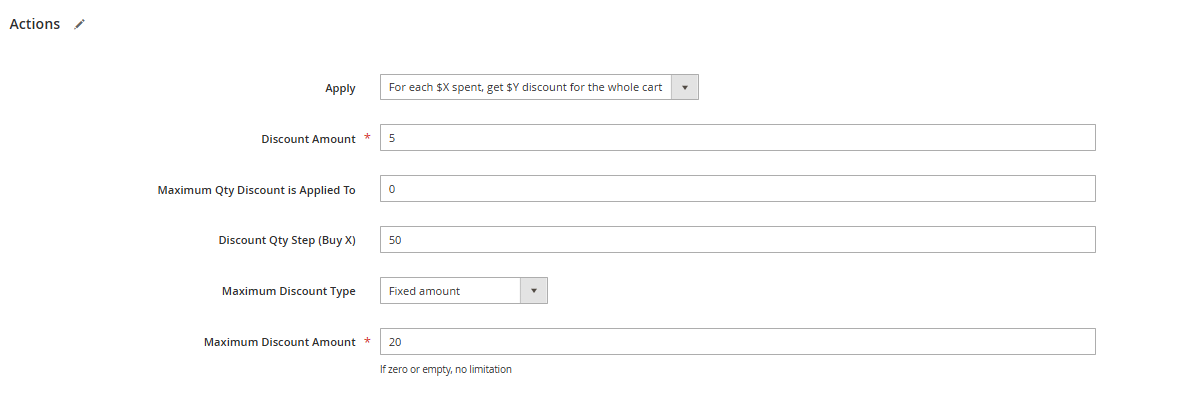
Example: A $120 cart gets $10 off. A $160 cart gets $15. A $400 cart stops at the $20 cap. Native Magento needs a separate rule for each threshold; here one rule handles them all, because the discount grows with every $50 spent.
Tip: Set the first step a little above your current average order value, so the rule pulls orders up instead of discounting ones that would have happened anyway. To tie the reward to individual products rather than the cart, use the per-item version of the same action.
2. Buy one product, get a different one free
The situation: You are launching a new accessory, or you have slow-moving stock you want to attach to a best seller.
The rule:
- Apply: Buy X get Y
- Conditions: the product being bought (X), e.g. category is T-shirts
- Actions conditions: the product being given (Y), e.g. SKU is the tote bag
- Discount Qty Step (Buy X): 3
- Discount Amount: 1 (the free quantity of Y)
Example: Buy three T-shirts, get a tote bag free. X and Y must be different products, which is exactly what the native rule can’t do: Buy X Get Y in native Magento only gives away more units of the same item.
Tip: When the gift is the campaign itself, shown on the product page or picked by the shopper from a short list, see our guide to free gift promotions.
3. Buy 3, pay for 2: a bundle product discount on the cheapest item
The situation: Holiday gift sets, mix-and-match beauty minis, stocking fillers. You want a bundle offer without building a bundle product for every combination shoppers might choose.
The rule:
- Condition: cart contains at least 3 items from the “Holiday minis” category
- Apply: Percent of product price discount
- Discount Amount: 100
- Additional Item Action: Cheapest item.
- Qty of applied products: 1
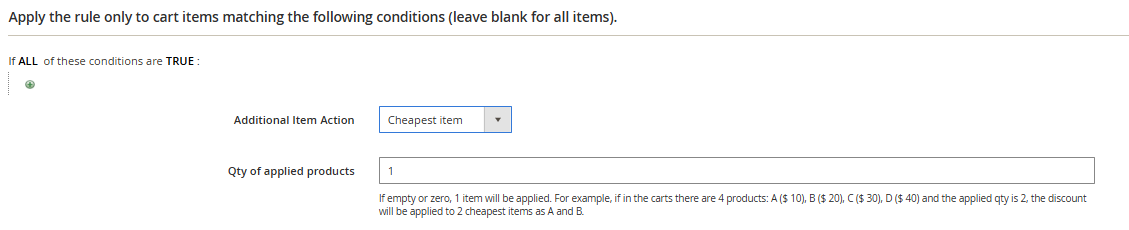
Example: A shopper picks items at $18, $22, and $25. The $18 item is free. A flat 33% off the same cart would cost you $21.45, and it would discount the expensive item too.
That makes this the most flexible way to get a Magento 2 bundle product discount. A native bundle product fixes the combination in advance. A cheapest-item rule works on whatever the shopper puts together, and you can raise “Qty of applied products” to 2 for buy 6, pay for 4.
4. Discount the most expensive item to sell premium lines
The situation: Your premium line moves slower than the rest of the catalog, or you need to clear high-ticket stock before the new season lands.
The rule:
- Condition: cart contains at least 2 items
- Apply: Percent of product price discount
- Discount Amount: 15
- Additional Item Action: Expensive item
- Qty of applied products: 1
- Maximum Discount Type: Fixed amount
- Maximum Discount Amount: 50
Example: A cart holds a $240 jacket and a $40 scarf. The jacket gets $36 off, and the saving lands on the item the shopper was most likely to hesitate over.
This costs more per order than a cheapest-item deal, so always set a cap. More on keeping that cost in check below.
Run seasonal and holiday campaigns
5. Flash prices: “Everything $19” with a to-fixed amount discount
The situation: A 48-hour flash sale on winter accessories. The items have different original prices, and you want one message shoppers understand at a glance: everything $19.
Native Magento gives you two ways to get a special price in Magento 2: the Special Price field on each product, or a catalog price rule. Both change the price everyone in the customer group sees on the catalog. A to-fixed amount discount sets the price in the cart instead, so the $19 offer can sit behind a coupon, a customer segment, or a cart condition.
The rule:
- Condition: category is Winter accessories
- Apply: To-fixed amount discount
- Discount Amount: 19
- Coupon: Specific coupon, FLASH19
- From / To: a 48-hour window
- Skip Special Price/Tier Price: Yes
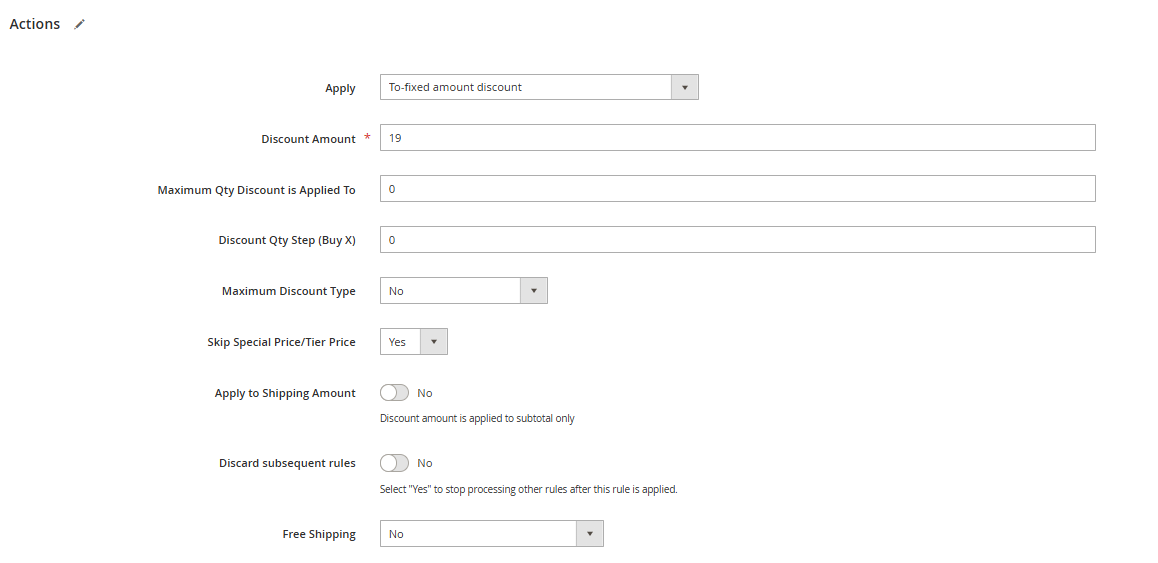
Example: A $29 beanie, a $34 scarf, and a $45 pair of gloves each ring up at $19 with FLASH19. Send the code to your email list only, and the sale stays out of the public catalog. Skip Special Price/Tier Price keeps the rule off items that already carry a special price, so nothing gets discounted twice.
Pair it with: Flash prices are one of the easiest Black Friday and Cyber Monday offers to run in waves: a new category every few hours, each with its own code.
6. Early-bird offers for shoppers who buy before the rush
The situation: You want to encourage spendings from early-bird shoppers, when shipping is cheaper and stock is easier to plan.
The rule:
- Condition: If total paid amount equals or greater than 1 for a subselection of orders matching ALL of these conditions:
- Order Created Date equals or greater than 2026-10-01
- Order Created Date equals or less than 2026-10-31
- Apply: Percent of product price discount
- Discount Amount: 10
- From / To: November 27 to November 30, 2026
Example: Everyone who orders in October gets an email: “Your Black Friday discount is already waiting.” From Black Friday to Cyber Monday, their cart takes 10% off with no code to remember. Order-history conditions only work for logged-in customers, so ask early-bird buyers to create an account at checkout.
Pair it with: View the seasonal marketing calendar to set the dates beforehand.
7. Let shoppers pick their coupon from a list in the cart
The situation: During holiday week, there are multiple eligible coupon codes at once. Shoppers leave the cart to look for them in their inbox or on coupon sites, and some never come back.
The rule:
- Enable Coupon Pickup: Yes
- Create one rule per offer, each with its own coupon code
- Write each rule’s description for shoppers, not for your team
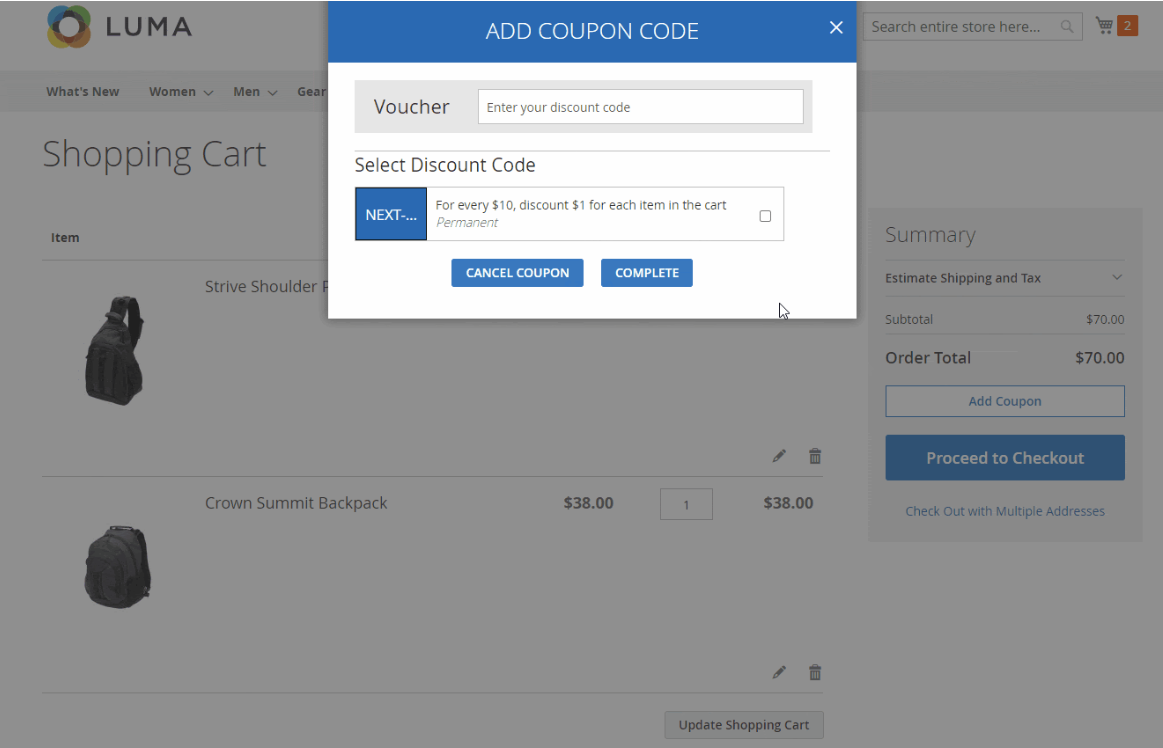
Example: The shopper clicks Add Coupon in the cart summary. A popup opens with the usual code field and, below it, a list of available codes: FREESHIP75, GIFT10, BF20, each with a one-line description of the deal and how long it lasts. They tick one, click Complete, and never leave the page. A description like “For every $10, get $1 off each item” does more work in that list than an internal note like “BF tier rule v2”.
Pair it with: To generate codes in bulk or let shoppers apply more than one, see the Coupon Code extension.
Bring customers back
8. Reward your best customers by order history
The situation: A small group of customers drives a large share of revenue, and you want to target them again by offering exclusive discounts.
The rule:
- Condition: If total paid amount equals or greater than 500 for a subselection of orders matching ALL of these conditions:
- Order Status is one of Complete
- Apply: Percent of product price discount
- Discount Amount: 10
- No end date
Example: A customer with $620 in completed orders gets 10% off every order for the rest of the year. A customer who placed $600 in orders and returned most of them does not, because the rule only counts completed orders. For a stricter filter, add a second subselection on total refunded amount.
Pair it with: This works as the entry tier of a loyalty program. Any stores should create a loyalty program to save on acquiring new customers.
9. Follow up with holiday buyers in January
The situation: Holiday shoppers bought gifts for other people; therefore, January is quiet, and most of them have no reason to come back. You need to create campaigns to encourage them to spend more in January.
The rule:
- Condition: If total paid amount equals or greater than 1 for a subselection of orders matching ALL of these conditions:
- Order Created Date equals or greater than 2026-11-01
- Order Created Date equals or less than 2026-12-31
- Apply: Percent of product price discount
- Discount Amount: 15
- From / To: January 5 to January 31
- Discard subsequent rules: Yes
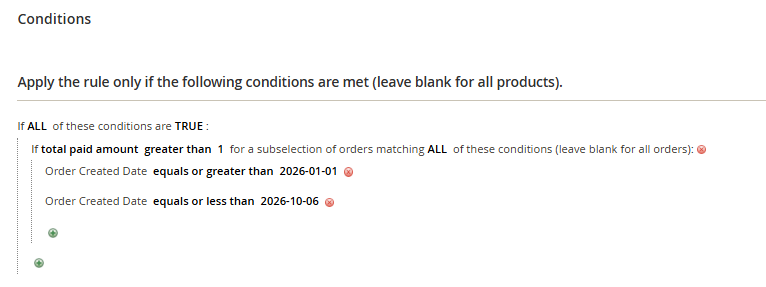
Example: A shopper who bought three gifts in December gets “15% off something for yourself” in January. Discard subsequent rules stops the offer stacking with your clearance rules.
Gift card buyers fit the same rule, and the people who receive those cards are new customers you can’t target by history yet. Put a first-order coupon in the email that delivers the card, and both sides of the gift come back.
Keep promotions from eating your margin
Nine promotions running at once can add up to a discount nobody planned. Special Promotions gives you a few controls to keep that in check:
- Cap each rule: Set Maximum Discount Type to
Fixed amountorPercent of cart subtotal, then enter the Maximum Discount Amount. Tiered and most-expensive-item rules need this most, because their discount grows with the cart. - Cap the whole cart: In the extension’s configuration, a maximum discount for the whole cart applies across every rule. When a rule cap and the cart cap both apply, the smaller one wins: a rule capped at $10 under a $5 cart cap gives $5.
- Stop rules stacking: Give each rule a priority and set Discard subsequent rules to
Yeson the ones that shouldn’t combine. Your loyalty discount and a Black Friday flash price probably shouldn’t. - Keep shipping out: Apply to Shipping Amount is off by default, so discounts come off the subtotal only. Leave it that way unless free shipping is the offer.
- Show the breakdown: Shoppers see each discount listed separately at checkout, which means fewer “why is my total different?” emails.
- Test on the live store first: Developer Mode shows discount details only to the IP addresses you add, so you can check a rule against real carts before customers see it.
For the pricing side of the same problem, see how to price to protect your margins.
What to do next
You don’t need all nine promotions this season. Just pick the one that matches the problem in front of you and build from there:
- Start from your numbers. Pull your average order value and your share of repeat customers for the last 90 days. A low order value points to tiered spend or buy 3, pay for 2. A thin base of repeat buyers points to early-bird offers and the January follow-up.
- Build one rule, with a cap. Set the maximum discount on day one, not after the first expensive weekend. Check the rule in Developer Mode against a few real carts, then switch it on.
- Plan the stack before the season starts. List every promotion you’ll run from late October to January. Decide which ones may combine, then set priorities and Discard subsequent rules before the first goes live. Untangling two overlapping rules in the middle of Black Friday week costs more than either discount.
- Measure, then add the next one. After two weeks, compare order value and total discount spend with the weeks before. Keep what moved the number, drop what didn’t, and move to the next use case on the list.
- Add the right tool as the plan grows. Special Promotions is one Magento 2 promotions extension among several, and each handles a different job. Most holiday plans end up using more than one:
- Discounts based on cart contents, order history, or which item is in the cart: Special Promotions.
- Gifts added to the cart, or chosen by the shopper: Free Gifts.
- Stored value for holiday gifting: Gift Card.
- Codes generated in bulk, or several applied to one order: Coupon Code.
- Points that reward repeat purchases: Reward Points.
FAQ
Can Magento 2 do tiered discounts without an extension?
Partly. You can create one cart price rule per threshold and order them by priority, but each rule gives a fixed discount at one threshold. A discount that grows with every $X spent needs the “For each $X spent, get $Y discount” action in Special Promotions.
Can I discount only the cheapest item in the cart?
Not with native Magento 2 promotions. Special Promotions adds Additional Item Action, which applies the discount to the cheapest or most expensive items, and Qty of applied products sets how many.
Does Special Promotions work with Hyvä and GraphQL?
Yes. It is compatible with API and GraphQL, and Mageplaza provides Hyvä and Hyvä Checkout compatibility free on request for active subscriptions.
Can these promotions stack with coupon codes?
Yes. Rules apply in priority order, and a coupon rule can stack with automatic ones unless a rule higher up has Discard subsequent rules set. A whole-cart maximum discount caps the combined total.
Build your first advanced promotion
Native cart price rules will carry you through simple offers. When the plan needs Magento advanced promotions, such as discounts that grow with the cart, deals on a single item, or offers based on what a customer has already bought, Special Promotions adds those rules to the admin you already use.
Table of content

Jacker is the Chief Technology Officer (CTO) at Mageplaza, bringing over 10 years of experience in Magento, Shopify, and other eCommerce platforms. With deep technical expertise, he has led numerous successful projects, optimizing and scaling online stores for global brands. Beyond his work in eCommerce development, he is passionate about running and swimming.
Related Post

15 mins read
|
09-30-2026
16 mins read
|
08-30-2026
5 mins read
|
07-30-2026
7 mins read
|
06-30-2026

How to Enable DebugView in GA4 for your Magento 2 store - Mageplaza
Step-by-step guide to enabling GA4 DebugView for Magento 2 merchants — verify your GA4 events are firing correctly before trusting your data.
8 mins read
|
06-09-2026
9 mins read
|
10-30-2026
15 mins read
|
09-30-2026
16 mins read
|
08-30-2026
5 mins read
|
07-30-2026
7 mins read
|
06-30-2026
How to Enable DebugView in GA4 for your Magento 2 store - Mageplaza
Step-by-step guide to enabling GA4 DebugView for Magento 2 merchants — verify your GA4 events are firing correctly before trusting your data.
8 mins read
|
06-09-2026