

13 mins read
|
10-30-2026
How to Build Customer Loyalty in E-commerce: 7 Proven Strategies
Summer Nguyen
|
04-20-2026

Increasing customer retention by just 5% can boost profits by 25–95% (Retenzy).
Everyone knows it. The problem is most advice on the topic is vague: “provide great service,” “offer rewards,” “engage on social media.” Useful in theory, but vague in practice.
This guide is a practical, data-backed playbook covering 7 proven strategies to encourage customer loyalty in e-commerce, with real examples from successful brands. Whether you’re just starting out or scaling past seven figures, there’s a clear starting point for where your store is right now.
Customer Loyalty vs. Customer Retention: What’s your goal?
Most e-commerce stores conflate these two concepts: customer loyalty and customer retention, then end up optimizing for the wrong thing.
Retention keeps customers from leaving. Loyalty makes them not want to. Here’s a quick breakdown:
| Criteria | Customer Retention | Customer Loyalty |
|---|---|---|
| Definition | Keeping existing customers from churning | Emotional commitment to repeatedly choose your brand over competitors |
| Driven By | Convenience, habit, switching costs | Trust, emotional connection, brand values |
| Customer Mindset | "I stay because it's easy" | "I stay because I genuinely prefer this brand" |
| Key Tactics | Subscriptions, auto-renewal, re-engagement emails, exit offers | Loyalty programs, VIP perks, personalization, community, UGC |
| Key Metrics | Retention rate, churn rate, repeat purchase rate | NPS, CLV, referral rate |
| Relationship | A retained customer is not necessarily loyal | A loyal customer is almost always retained |
What suits you best?
- Early-stage stores: Retention first. Customers don't know you yet. Nail the basics like fast shipping, responsive support, smooth checkout. There's no point building a loyalty program if the core experience isn't there yet.
- Growing stores: Focus on retention + start building loyalty. You have enough repeat buyers to measure. Add a referral or basic points program to reduce re-acquisition costs and identify your most engaged customers.
- Established stores: Focus on loyalty, as retention is already stable. The next lever is deepening relationships with your best customers. Tiered rewards, VIP access, and personalization pay off most here.
- Subscription & consumables brands: Retention first, loyalty to compound. Lock in habit formation and value stacking first. Once subscribers are stable, loyalty mechanics (milestone rewards, referrals) compound retention into advocacy.
- B2B stores: Focus on loyalty. Retention in B2B is often contractual. The real opportunity is turning satisfied accounts into advocates. Account-level perks and volume rewards drive more impact than points systems.
How to build customer loyalty in e-commerce: 7 proven strategies
Optimize the store experience
Before investing in retention mechanics, get the foundation right, because no customer becomes loyal to a store that frustrates them.
-
Speed is the silent loyalty killer: Google’s Core Web Vitals are the authoritative benchmark: Largest Contentful Paint (LCP), Interaction to Next Paint (INP), and Cumulative Layout Shift (CLS). Treat these not just as SEO metrics but as loyalty metrics - a signal that you respect your customer’s time.
-
Navigation & search help customers find what they came for: Customers who can’t find what they need in two or three clicks leave and don’t come back. Advanced filtering, smart autocomplete, and logical category structures remove friction at the exact moment purchase intent is highest.
-
Mobile-first is non-negotiable: A desktop-optimized store with a mediocre mobile experience means the majority of your visitors are already having a subpar interaction before they’ve seen a single product.
Speed, navigation, and mobile optimization are foundational—but so is protecting the infrastructure that powers your store. For e-commerce teams managing payment gateways, secure admin access, and third-party integrations across multiple locations, a dedicated IP VPN ensures stable, trusted connections that prevent IP blacklisting and reduce security risks as your business scales.
Build personalized marketing that feels human
Personalization is one of the highest-ROI levers in e-commerce — but done poorly, it feels like surveillance. The difference between a customer thinking “this store gets me” versus “how did they know that?” comes down to three things: relevance, timing, and consent.
Personalization approach includes:
-
Product recommendations: Real recommendations are built on what each customer has browsed, bought, and skipped. AI-powered engines in e-commerce stores spot product relationships across thousands of SKUs and update in real time as behavior changes. A customer who just bought a coffee machine doesn’t need another coffee machine, they need beans, a grinder, and descaling tablets. An AI figures that out automatically, for every customer, at scale.
-
Behavioral email triggers: Instead of scheduling campaigns manually, AI triggered emails monitors individual behavior in real time and fires the right email at the right moment: an abandoned cart reminder 2 hours after a customer leaves, a post-purchase follow-up when the product is likely to have arrived, a win-back offer precisely when a lapsed buyer’s engagement score starts to drop. The timing is automatic. The relevance is built in.
-
Personalized discounts: A 10% discount offered to everyone cheapens your brand. The same discount offered to a customer who hasn’t purchased in 60 days, on the exact category they last browsed, feels like you’re paying attention.
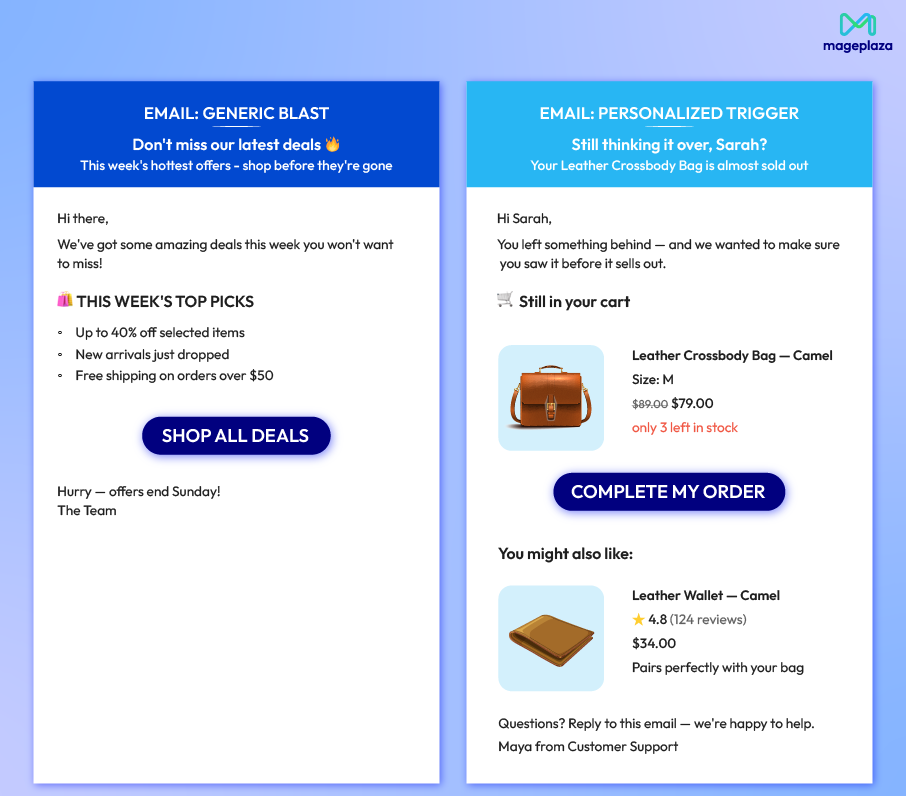
Let’s take a look at an example of why personalization wins:
| Criteria | Generic Blast | Personalized Trigger |
|---|---|---|
| Subject line | "Don't miss our latest deals 🔥" | "Still thinking it over, [Name]?" |
| Sent when | Every Tuesday, 10am | 2 hours after cart abandonment |
| Content | This week's promotions | The exact product left in cart + a related item |
| Tone | Broadcasting to a list | Talking to one person |
| Typical conversion | 1–3% | 8–15% |
💡 Magento Tip: Do it without crossing privacy lines. Be transparent about what you collect and why. Customers are far more comfortable with personalization when they understand the value exchange.
Design a loyalty program customers actually use
Most loyalty programs don’t fail because of bad intentions. They fail because they’re either too complicated to bother with or too stingy to feel worthwhile.
The best programs share two traits: deliver value early and stay simple enough.
Learn more about current program types in our complete guide to e-commerce loyalty programs.
What makes programs fail:
- Too many steps to redeem: If claiming a reward requires more than two clicks, most customers won’t bother.
- Low perceived value: Earning 10 points per dollar when 10,000 points equals $1 off is technically a reward, but it doesn’t feel like one.
- One-size-fits-all structure: A wholesale B2B buyer and a casual B2C shopper have completely different motivations. Treating them identically leaves value on the table for both.
💡 Magento Tip: Mageplaza Magento 2 Reward Points extension lets you set up a fully customizable points-based system to earn, redeem, and reward directly on your Magento store.
Create VIP & exclusive perks to drive repeat purchases
The most effective perks aren’t always the most expensive ones.
Robert Cialdini identified both decades ago: reciprocity (when you give customers something unexpected, they feel compelled to give back) and exclusivity (people place higher value on things they perceive as scarce or members-only). VIP programs work because they engineer both responses simultaneously. The customer doesn’t just feel rewarded. They feel chosen.
Here are some perks worth building into your program:
- Early sale access: Let VIP members shop 24–48 hours before a public promotion. The perk costs nothing but feels premium.
- Members-only pricing: A persistent, visible discount tier for loyal customers reinforces the value of staying in the program.
- Free shipping thresholds: Unlocking free shipping at a loyalty tier (rather than a cart value) shifts the psychological frame from “spend more” to “you’ve earned it.”
- Birthday rewards: Automated, personal, and highly redeemable. Birthday emails have some of the highest open and conversion rates of any triggered communication.
- Surprise-and-delight moments: An unexpected free sample, a handwritten note, a bonus gift on a customer’s 10th order. These create stories customers actually tell other people.
Deliver customer support that builds trust
Your competitors can copy your prices, your promotions, and even your products. They can’t easily replicate a support experience that makes customers feel genuinely looked after. That’s where long-term loyalty is quietly built or quietly lost.
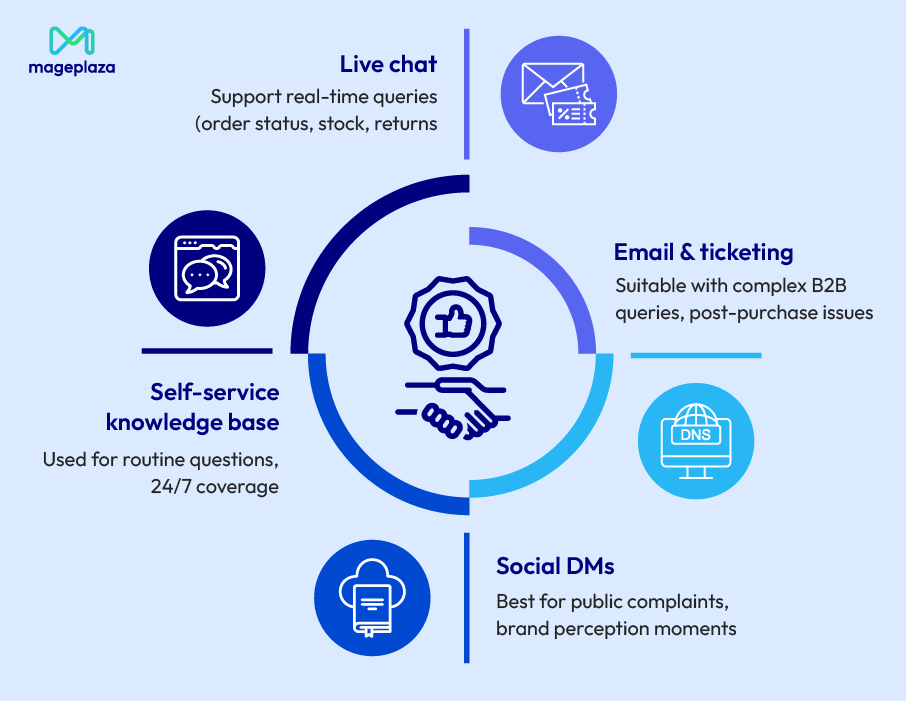
Build support across every touchpoint:
- Live chat: Even a well-configured AI bot handling routine queries (order status, return windows, stock questions) frees human agents for complex issues. Consider multilingual customer support as a loyalty multiplier, especially for stores expanding into new markets.
- Email & ticketing: For detailed B2B queries or post-purchase issues, email remains essential. Speed and clarity of resolution matter more than the channel itself.
- Social DMs: Public-facing support on Instagram, Facebook, or TikTok signals transparency. A fast, helpful reply to a complaint does more for brand perception than any ad campaign.
- Self-service knowledge base: A well-structured FAQ and help center reduces inbound volume while keeping customers unblocked 24/7.
💡 Magento Tip:
- Go proactive, not just reactive: Don't wait for customers to complain. Communicate first. Proactive order update notifications, shipping delay alerts, and stock warnings resolve frustration before it becomes a complaint.
- Prepare for returns & refunds: Customers who have a smooth return experience are more likely to buy again than customers who never had a problem at all. Clear returns policy wins both the repeat purchase and the trust.
Use social proof & UGC to build a community
Reviews can build customers’ trust, but that’s the story of customer retention. To encourage customer loyalty, you need to expand it to the bigger idea: community-building. When customers feel like they’re part of something, they don’t just repurchase. They advocate, defend, and recruit.
The shift from “collect reviews” to “build community” is one of the highest-leverage moves a brand can make, and it costs far less than most loyalty programs.
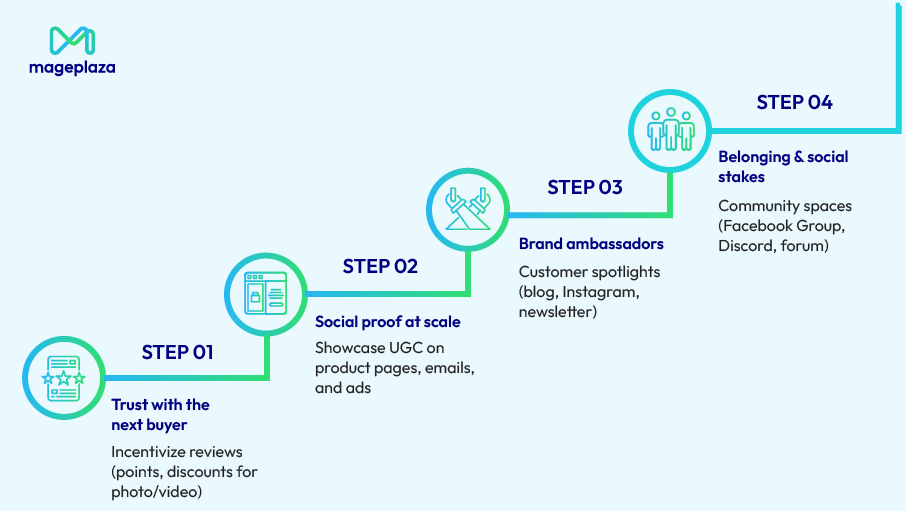
Start with reviews, then go further:
- Incentivize reviews with rewards: Offer points or a small discount for leaving a review, with higher rewards for photo or video submissions. Visual reviews convert better and generate UGC you can repurpose across channels.
- Showcase UGC on product pages and social: Real customers wearing, using, or living with your product is more persuasive than any product photo you shoot. Pull UGC directly onto product pages, email campaigns, and paid ads.
- Customer spotlights: Feature real customers on your blog, Instagram, or email newsletter. A “Customer of the Month” spotlight costs nothing and makes that customer a brand ambassador for life.
- Community spaces: A branded Facebook Group, a Discord server, or even a dedicated forum gives loyal customers a place to connect with each other. Brands with active communities report significantly higher repeat purchase rates because customers have social stakes in staying connected.
💡 Magento Tip: Mageplaza Product Reviews for Magento 2 makes it easy to collect, display, and incentivize product reviews directly on your Magento store.
Use data & testing to improve loyalty
Most loyalty programs launch strong and quietly decay. Rewards stop feeling relevant, engagement drops, and merchants assume loyalty “doesn’t work”, when the real issue is that the program was never updated based on how customers actually behave.
To fix it, you need to understand what your customers tell you via data:
| Metric | What It Tells You |
|---|---|
| Repeat purchase rate | Are loyalty efforts actually bringing customers back? |
| Customer Lifetime Value (CLV) | Are loyal customers spending more over time? |
| Churn rate | At what point do customers stop returning and why? |
| Loyalty program engagement | Are members redeeming rewards, or just collecting points they never use? |
| RFM score (Recency, Frequency, Monetary) | Who are your highest-value segments right now? |
How to act on it:
- A/B test your loyalty mechanics: Test reward thresholds, email subject lines, discount types (% off vs. fixed amount), and redemption triggers. Small changes compound significantly at scale.
- Use RFM segmentation: Group customers by how recently they bought, how often, and how much. Each segment needs a different message: a lapsing high-spender needs a win-back offer, not a first-purchase welcome.
- Kill what isn’t working: If a reward tier has low redemption, the perceived value is too low. If a campaign has low open rates, the segmentation is off. Data gives you permission to cut and iterate fast.
💡 Magento Tip: Track loyalty performance directly inside your store with Mageplaza Magento 2 Reports extension and connect behavioral data via Google Analytics.
Case Studies: How real brands built lasting customer loyalty
Temu and the gamification & retention at scale
Launched in 2022 and owned by PDD Holdings, Temu is a cross-border marketplace known for ultra-low prices and an addictive, game-like shopping app. It grew from 4.6 million to 82.4 million active shoppers in just its first year in the U.S., according to ContactPigeon.
Its challenge is to convert price-driven, one-time bargain hunters into habitual repeat buyers without endlessly subsidizing acquisition with deep discounts.
Loyalty Strategy:
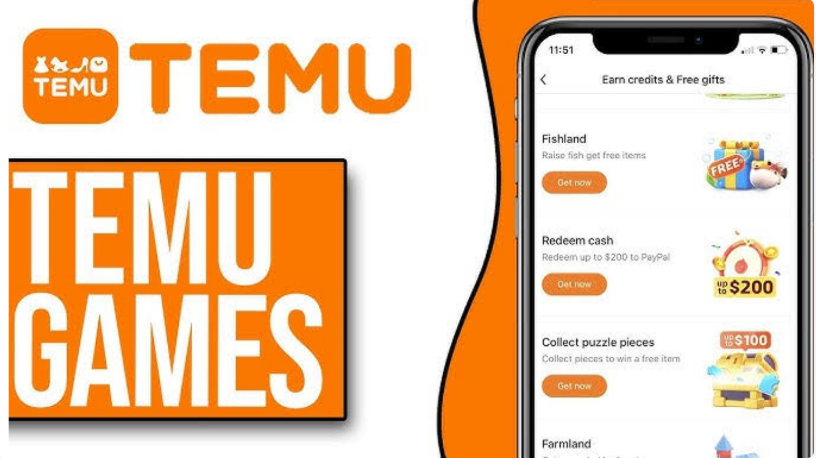
- Gamified mechanics such as check-ins, spin wheels, referral bonuses, and daily missions nudge customers toward daily app opens and threshold-based savings
- Cooperative features like team deals and invite trees turn buyers into active recruiters
- Temu Circle rewards consistent engagement with free shipping and early access to seasonal drops
- AI-driven product feeds keep the experience feeling personally curated
Results:
- 70% of Temu shoppers are repeat buyers, with over a third purchasing at least once a month (eMarketer)
- 28% of customers made a purchase 16 months after their first order (ChannelX)
💡 Key Takeaway: Daily engagement mechanics (streaks, spin rewards, milestone bonuses) are powerful retention tools for any e-commerce store, especially on mobile. Make loyalty feel like a game, not a chore.
Chewy & the subscription loyalty flywheel in pet care
Chewy is the dominant pure-play e-commerce retailer for pet products in the U.S., serving over 21 million active customers with roughly 130,000 products. Unlike fashion or general retail, Chewy competes in a category where purchases are frequent, emotionally driven, and highly habitual, making loyalty engineering especially impactful.
Pet supply purchases are inherently recurring (food, medication, litter), but that doesn’t guarantee loyalty to one retailer. Chewy needed to convert habitual buyers into locked-in customers who would grow their spend over time, not comparison-shop for every order.
Loyalty Strategy:
- Autoship (free subscription with perks): Customers set up scheduled deliveries and receive discounts, priority shipping, and price locks.
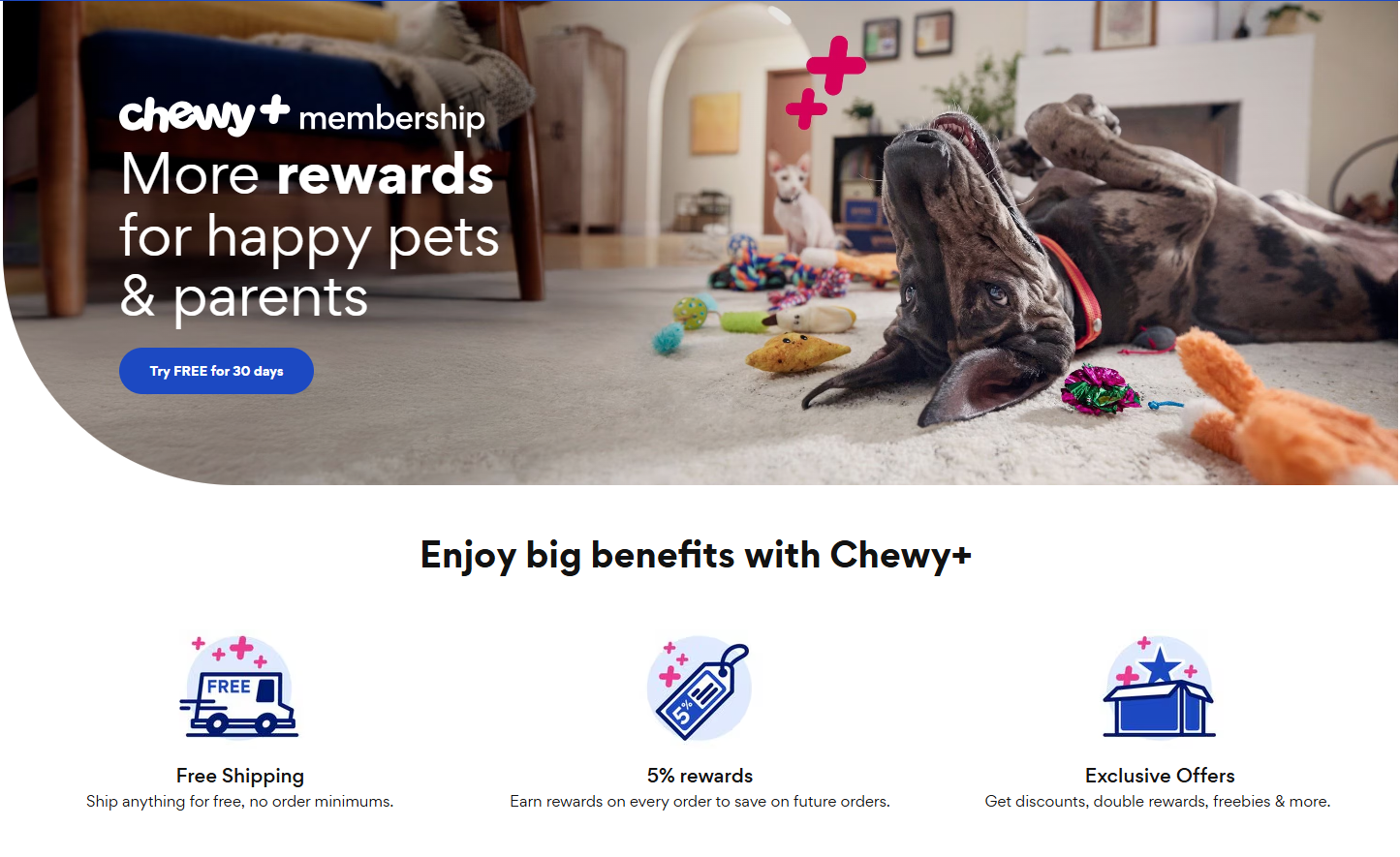
- Chewy+ (paid membership, launched 2024): For $49 a year (later raised to $79), Chewy+ offers free shipping with no order minimums, 5% rewards on every order, and exclusive discounts and freebies.
- Ecosystem expansion: Chewy Vet Care locations serve as both an acquisition channel and a loyalty deepener.
- Mobile + personalization: App customers and orders grew with AI-driven personalization lifting direct traffic and improving conversion. Alibaba
Results:
-
Autoship sales hit $10.06 billion in twelve months until QII 2025, representing 83% of total net sales. (Accio)
-
Chewy ended QIII 2025 with 21.2 million active customers. (Loyalty & Reward Co)
💡 Key Takeaway: The most durable loyalty is built on convenience and habit. Subscription-based loyalty (recurring delivery, scheduled restocking) removes the friction of repeat purchasing entirely. If your store sells consumables or replenishable products, an Autoship-style mechanic is one of the highest-ROI loyalty investments you can make.
Wayfair Rewards: How a Furniture Giant Used Paid Loyalty
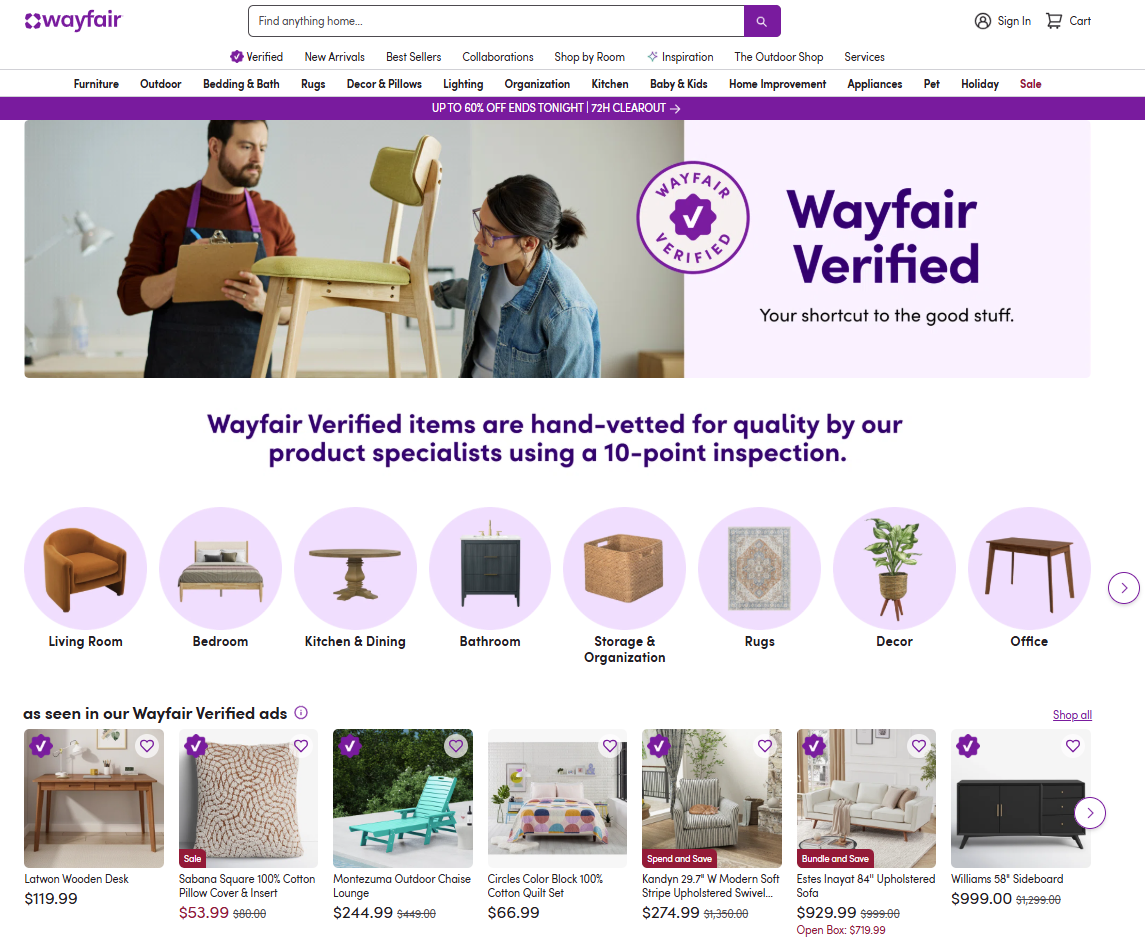
Wayfair is North America’s largest pure-play online home goods and furniture retailer, operating across five brands: Wayfair, AllModern, Birch Lane, Joss & Main, and Perigold. It competes in one of e-commerce’s most difficult loyalty categories: high-ticket, infrequent purchases in an inactive housing market.
Furniture shoppers don’t buy weekly. Wayfair faced low natural purchase frequency, heavy reliance on paid advertising to re-acquire its own customers, and intense competition from Amazon and category specialists. Wayfair needed a loyalty structure that would drive customers back without relying on discounts alone.
Loyalty Strategy:
-
Wayfair Rewards (launched October 2024): For $29 per year, members receive 5% back in rewards on all purchases, free shipping on orders of any size, early access to major sales events like Way Day, priority customer service, and a birthday offer with rewards that never expire as long as membership is active.
-
Multi-brand coverage: Wayfair Rewards extends across the company’s entire brand portfolio, meaning a customer shopping Birch Lane for traditional furniture and Joss & Main for modern pieces earns within the same loyalty account — a powerful cross-brand retention mechanic.
-
Wayfair Verified (quality curation layer): Wayfair introduced a “Verified” checkmark program signaling quality and reliability, to which customers responded positively.
-
App + direct traffic flywheel: Wayfair Rewards generates incremental share of wallet and order momentum while naturally driving more direct traffic as customers return to spend their reward dollars.
Results:
-
Within its first year, Wayfair Rewards surpassed 1 million members and drove more than 15% of U.S. revenue (Yotpo)
-
Recent member cohorts were comprised of over 50% previously non-active customers (Antavo)
💡 Key Takeaway: If your store sells big-ticket items that customers don’t buy often, a low-cost paid membership that delivers immediate, tangible value (free shipping alone often justifies the fee) can fundamentally restructure your retention economics.
The bottom line
Customer loyalty can make your store surpass others, but it’s a system to build. A store that earns the first visit, personalization that makes the second feel inevitable, and a community that makes leaving feel like a loss.
Start with the one that maps most directly to where your store is right now, and let it compound from there.
Table of content

Summer is the CMO and Digital Commerce Solution Expert with 10+ years of experience. She specializes in Magento, Shopify, ERP, CRM, AI, and Blockchain, delivering strategic solutions that transform businesses. With a deep understanding of digital commerce, she helps brands scale and stay ahead in a competitive market.
Related Post

15 mins read
|
09-30-2026
16 mins read
|
08-30-2026
5 mins read
|
07-30-2026
7 mins read
|
06-30-2026
How to Enable DebugView in GA4 for your Magento 2 store - Mageplaza
Step-by-step guide to enabling GA4 DebugView for Magento 2 merchants — verify your GA4 events are firing correctly before trusting your data.
8 mins read
|
06-09-2026
13 mins read
|
10-30-2026
15 mins read
|
09-30-2026
16 mins read
|
08-30-2026
5 mins read
|
07-30-2026
7 mins read
|
06-30-2026
How to Enable DebugView in GA4 for your Magento 2 store - Mageplaza
Step-by-step guide to enabling GA4 DebugView for Magento 2 merchants — verify your GA4 events are firing correctly before trusting your data.
8 mins read
|
06-09-2026