

2 mins read
|
10-30-2026
HubSpot vs Salesforce – Which Is the Better One?
Summer Nguyen | 05-09-2024
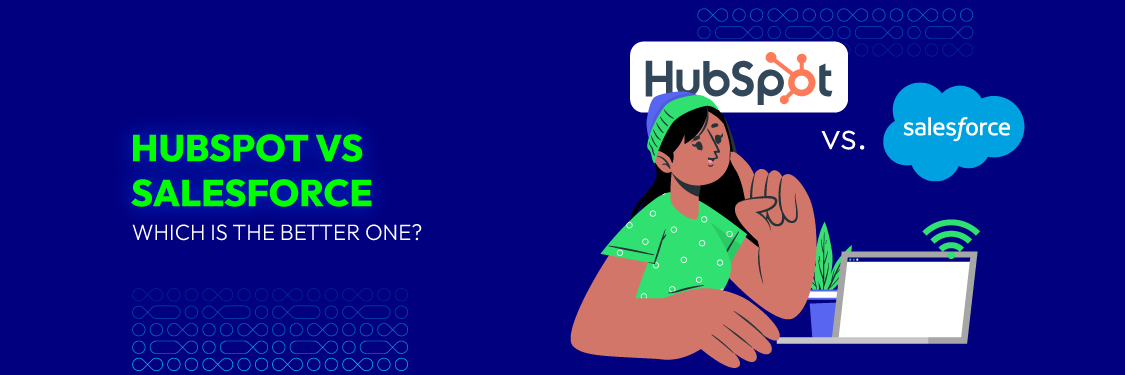
CRM software can be super confusing, right? Don’t worry—this article has you covered! CRM software is important to businesses.
This article will compare HubSpot vs Salesforce, the main CRM choices. We’ll look at their features, prices, how well they work with other apps, and how they perform.
We will also discuss the importance of CRM. We’ll also dig into the small differences between these top choices.
Salesforce vs. HubSpot: Key Learnings
Now let’s examine the chart. It describes the primary distinctions between HubSpot vs Salesforce. We’ll delve deeper into each one later:
| Differences | HubSpot | Salesforce |
| Target audience | HubSpot helps small and medium-sized businesses, including startups, with inbound marketing strategies. | Salesforce works for all types of businesses, big or small. It helps with managing relationships with customers and can be customized to suit individual needs. That’s why it’s popular with sales teams and large companies. |
| Features | HubSpot offers tools like email, social media, content creation, and sales help for inbound marketing. | Salesforce helps you keep track of and maintain good connections with your customers. It offers customized features for sales, marketing, and customer service. It also has them for analytics and app development. |
| Pricing | Hubspot offers custom pricing tiers for marketing, sales, and service hubs. The plans scale for businesses of all sizes. They also offer a free CRM with limited features. | Salesforce provides low-cost, flexible solutions. You buy them through subscriptions, add-ons, and industry-specific options. Advanced features and customizations have extra costs. |
| Free trial | HubSpot provides free trials for marketing, sales, and service centers. It lets users test features, including basic CRM. | Salesforce offers a free trial. Users can use it to explore its main features and options for customization. However, advanced features may need a paid plan. |
| Ease of use | Hubspot is simple to use. It offers an easy design. It is for use across various technical levels. | Salesforce is powerful and customizable. But, it has a steeper learning curve than HubSpot. This is due to its many features and complex options. |
| Customization | HubSpot offers customization options for workflows, templates, and reports. Yet, its capabilities may be limited compared to Salesforce. This is especially true for complex business processes and integrations. | Salesforce has many customization options. They include custom objects, fields, workflows, automation rules, and third-party app integrations. You can get these via the AppExchange marketplace. |
What is HubSpot?
HubSpot, founded in 2006 by Dharmesh Shah and Brian Halligan, offers tools and software to assist businesses with customer service, sales, and marketing. Its platform provides several tools.

The HubSpot platform facilitates lead conversion, customer acquisition, and visitor attraction for organizations. It provides resources for online presence management. They increase income, cultivate relationships, and produce leads.
Pros of HubSpot
Choosing HubSpot can be beneficial for several reasons:

- All-in-one platform. A wide range of tools are available from HubSpot on a single platform. This can simplify your operations. It will cut the need for multiple tools and improve integration across teams.
- Simple interface. HubSpot’s intuitive layout is well-known. It is intuitive. Users with different levels of technical expertise can use it. This can reduce the learning curve for your team. It can also increase productivity.
- Automation. HubSpot offers advanced automation features. They automate repetitive tasks, minimize workflows, and personalize interactions with leads and customers. This saves time and resources and improves marketing and sales.
- Analytics and reporting. HubSpot provides analytics and reports. They offer valuable insights into marketing, sales, and customer service performance. They enable informed decision-making and strategic optimization for improved results.
- Flexibility. HubSpot works for everyone, from small startups to big companies. Its adaptable pricing and tailored features suit all businesses. They work for any size or industry.
Cons of HubSpot
Although HubSpot has many benefits, it also has some drawbacks to consider:

- Integration limitations. HubSpot integrates with many popular platforms and tools. But, some users may find limits in connecting with certain third-party apps or systems. They rely on these tools for their business operations.
- Customization limitations. HubSpot offers templates and customization options. However, some users may find it restrictive. They can’t fully customize their marketing materials or workflows to fit their needs.
- Resource-intensive. Using HubSpot well takes much time and resources. You need them to make and manage campaigns, track performance, and tweak strategies.
What is Salesforce?
Parker Harris and Marc Benioff founded Salesforce back in 1999. It is a top global provider of CRM software. It offers a suite of apps. They are for sales, service, marketing, analytics, and app development.

Also, Salesforce is a centralized platform. It lets businesses manage customer interactions. They can track leads, manage sales, give support, and analyze data for decisions. It provides a wide range of features and choices for many sectors.
Salesforce is becoming an essential component of many companies’ operations. It helps them to streamline processes, improve customer relationships, and drive growth.
Read more: Hiring Salesforce Developer: In-depth guidance for your business
Pros of Salesforce
Some of the pros of Salesforce include:

- Customization. Salesforce offers extensive customization. It lets businesses tailor the platform to their needs. This includes customizing fields, workflows, and processes. It also involves aligning user interfaces with business goals.
- Ease of integration. Salesforce works with many third-party applications. This creates a unified ecosystem for businesses. It helps them streamline their operations.
- Mobile accessibility. Salesforce provides mobile apps for iOS and Android. They let users access CRM data and do tasks remotely. This boosts productivity and keeps sales and service teams connected with customers.
- Security and compliance. Salesforce focuses on keeping your data safe and meeting regulations. They also get certifications. The certifications ensure compliance and protect your information. They also meet legal standards.
- Continuous innovation. Salesforce is committed to innovation. It regularly releases updates and new features to improve its platform. This ensures businesses can use the latest technologies. It helps them stay ahead of the competition.
- Global reach. Salesforce is a flexible worldwide platform. Companies that do business abroad can use it. It supports several currencies and enables localization of CRM procedures.
Cons of Salesforce
Nevertheless, Salesforce has limitations just like any other software program. Here are some potential cons of Salesforce:

- User adoption. As with any new system, getting employees to use Salesforce and use it well can be hard. Users may need training and ongoing support. This will help them be comfortable with the platform and use it to its full potential.
- Performance issues. Some users have reported issues with Salesforce. This happens especially with large volumes of data or complex workflows. This can impact productivity and user satisfaction.
- Dependency on internet connectivity. Salesforce is a cloud-based platform. It relies on the Internet for remote work. This can be a problem for users if outages occur, despite its flexibility.
HubSpot vs Salesforce: Key features
1. Marketing features
HubSpot offers a user-friendly interface with tools for email marketing, social media management, content management, SEO optimization, and lead generation.

On the other hand, Salesforce provides marketing automation tools with features for email marketing, lead nurturing, advertising, and campaign management.
2. Sales features
HubSpot’s sales features often revolve around terms like “Deal Pipelines,” “Email Sequences,” and “Sales Automation.” The language emphasizes streamlining the sales process, managing contacts, and tracking deals through various stages.

Salesforce gives excellent sales tools with terminology such as “Opportunity Management,” “Sales Cloud,” and “Salesforce CPQ”. Its language may focus on features geared towards sales forecasting, territory management, and sales performance analytics.
3. Service features
HubSpot’s service features include a help desk, ticketing system, knowledge base, live chat, and customer feedback tools.

Conversely, Salesforce provides comprehensive service features such as case management, service level agreements, customer portals, field service management, and community forums.
4. Reporting and analytics
HubSpot offers intuitive reporting and analytics dashboards with insights into marketing, sales, and service performance. Users can track metrics like website traffic, lead conversion rates, and customer satisfaction.

For all that, Salesforce provides customizable reporting tools with deep insights into sales pipeline performance, customer behavior, and service efficiency. Users can create custom reports and dashboards tailored to their specific needs.
5. Integrations with other software
HubSpot offers a wide range of integrations with popular third-party apps and services, including CRMs, email marketing tools, social media platforms, and e-commerce platforms.

In other ways, Salesforce has an extensive ecosystem of integrations through its AppExchange marketplace, allowing users to connect with various business applications for marketing, sales, service, and more.
6. Ease of use
HubSpot’s smooth mix of marketing, sales, and support tools is well-known. These make it easy to use for users with varying technical skills.

Salesforce has many features and detailed choices for customization. But, it has a longer learning curve than HubSpot, despite its strength. To fully utilize its potential, more training, and technical understanding would be needed.
7. Customization
HubSpot offers customization options for workflows, templates, and reports. But, its abilities may be limited compared to Salesforce. This is especially true for complex business processes and integrations.

Salesforce also offers many customization options. These include custom objects, fields, workflows, and automation rules. You can also integrate third-party apps via the AppExchange marketplace. These options let users improve their platform.
Hubspot vs Salesforce: Cost to Use
Below is a simple comparison table between HubSpot and Salesforce, focusing on the cost of using each platform:
| Aspect | HubSpot | Salesforce |
| Pricing Model | Subscription-based, with various tiers | Subscription-based, with tiers |
| Basic Plan Cost | Starts around $50/month per user | Starts around $25/month per user |
| Additional Costs | Additional costs for add-ons and features | Additional costs for add-ons and features can become expensive with extensive customization |
| Enterprise Plan | Typically higher priced, offers more features and support | Also higher priced, provides advanced customization and extensive support |
| Free Trial | Offers a limited free version | Offers a limited free trial version |
This table simplifies the cost comparison between HubSpot and Salesforce, highlighting the basic pricing structure and additional considerations. Remember to check the most up-to-date pricing directly from the respective websites or by contacting their sales teams.
Hubspot vs Salesforce: Service Support
1. Training and educational resources
HubSpot provides extensive training resources through its HubSpot Academy, offering courses, certifications, and guides for users to learn the platform’s features and best practices.

Meanwhile, Salesforce offers Trailhead, a comprehensive learning platform with interactive tutorials, modules, and certifications designed to educate users on using Salesforce effectively.
2. Maintenance
HubSpot’s maintenance is typically handled by their team, ensuring updates and improvements to the platform. Users can access support for any maintenance-related issues.

However, Salesforce requires users to manage their maintenance, including updates and configurations, which may necessitate additional expertise or resources.
3. Support system
HubSpot offers support via phone, email, and live chat for users seeking assistance with platform usage, technical issues, or account management.

In addition, Salesforce also provides support through phone, email, and online case submission, enabling users to get help with various issues they encounter.
4. Technical support
HubSpot’s technical support is typically included in their subscription plans. However, for advanced support or dedicated assistance, costs can range from $250 to $1,000 per month, depending on the level of service required.

Compared to HubSpot, Salesforce offers different support plans with varying costs. For example, their Premier Success Plan, which includes 24/7 support, costs approximately $25,000 per year.
HubSpot vs Salesforce – Which is best for your business?
Several things affect choosing between HubSpot vs Salesforce. These include firm size, sector, specialized requirements, and budget.

Here’s a simple comparison to help you choose what’s best for different situations:
HubSpot:
- Good for small and medium businesses and startups.
- Ideal for businesses focused on attracting customers through inbound marketing strategies.
- Offers an interface and is easier to set up and use.
- Provides tools for marketing, sales, and customer service, all in one package.
- Affordable, with prices suited to various budgets. Paid plans start from around $50/month/user.
Salesforce:
- It is better for medium to large enterprises. They have complex sales processes and need lots of customization.
- It’s great for businesses. They focus on sales automation, customer relationship management (CRM), and big scale.
- Provides considerable customization and integration options through its AppExchange marketplace.
- Offers powerful tools for predicting sales, managing pipelines, and analyzing data.
- More expensive at first and takes more effort to learn compared to HubSpot. But, it offers more robust features for larger organizations.
- Higher price point, starting from around $75/month/user. Additional costs for add-ons and customization.
So, HubSpot is great for small and medium businesses, assisting with marketing, sales, and service. Salesforce is better for big companies needing flexible CRM and sales automation tools.
Ultimately, choose what’s right for your company considering its needs, budget, and future plans. Make sure to think carefully about your requirements before deciding. Consider variables like your company’s size, industry, and long-term ambitions.
Final thoughts
In conclusion, the choice depends on your business needs and preferences. You must choose between HubSpot vs Salesforce. Both are good for keeping track of customers and increasing sales.
HubSpot is great for small and medium-sized businesses. It’s easy to use and combines all your marketing, sales, and service tools in one platform. Salesforce is better suited for large enterprises. This is because it is flexible. It can handle complex sales and various needs.
Table of content

Summer is the CMO and Digital Commerce Solution Expert with 10+ years of experience. She specializes in Magento, Shopify, ERP, CRM, AI, and Blockchain, delivering strategic solutions that transform businesses. With a deep understanding of digital commerce, she helps brands scale and stay ahead in a competitive market.
Related Post

15 mins read
|
09-30-2026
16 mins read
|
08-30-2026
5 mins read
|
07-30-2026
7 mins read
|
06-30-2026
How to Enable DebugView in GA4 for your Magento 2 store - Mageplaza
Step-by-step guide to enabling GA4 DebugView for Magento 2 merchants — verify your GA4 events are firing correctly before trusting your data.
8 mins read
|
06-09-2026
2 mins read
|
10-30-2026
15 mins read
|
09-30-2026
16 mins read
|
08-30-2026
5 mins read
|
07-30-2026
7 mins read
|
06-30-2026
How to Enable DebugView in GA4 for your Magento 2 store - Mageplaza
Step-by-step guide to enabling GA4 DebugView for Magento 2 merchants — verify your GA4 events are firing correctly before trusting your data.
8 mins read
|
06-09-2026